- February 25, 2026
- Tejhaksh
- 0 Comments
- AI technologies, RPA, Uncategorized
What is Robotic Process Automation (RPA)? How It Works, Benefits, Use Cases & AI Integration
In today’s rapidly evolving digital landscape, organizations are constantly searching for innovative solutions to enhance productivity, cut operational costs, and streamline business processes. One of the most transformative technologies leading this shift is Robotic Process Automation (RPA). By automating repetitive, rule-based processes and integrating seamlessly with Artificial Intelligence (AI), RPA is transforming how modern enterprises optimize efficiency and scale their operations.
In this comprehensive guide, we will explore what is RPA, RPA explained in simple terms, how RPA works, the key benefits of Robotic Process Automation, RPA vs AI differences, real-world use cases of RPA, RPA implementation challenges, and much more to help you understand how intelligent automation can drive digital transformation in 2026 and beyond.
Robotic Process Automation
Robotic Process Automation (RPA) is an advanced automation technology that uses software robots, commonly known as “bots,” to perform repetitive, rule-based digital tasks with high speed and accuracy. These bots are designed to replicate human actions such as clicking, typing, extracting data, filling out forms, processing transactions, validating information, and generating reports across multiple applications.
Unlike traditional automation methods that require complex coding or system integration, RPA operates at the user interface (UI) level. This means RPA bots interact with software applications just like a human employee—logging into systems, navigating dashboards, entering data, and completing workflows—without the need for significant changes to existing IT infrastructure.
By automating routine and time-consuming processes, Robotic Process Automation helps businesses improve operational efficiency, reduce human errors, enhance productivity, and lower overall costs, making it a key driver of digital transformation in modern enterprises.
What is Robotic Process Automation?
If you’re asking What is Robotic Process Automation (RPA)?, the simplest way to understand it is to think of it as a digital or virtual workforce. RPA uses intelligent software bots to handle repetitive, rule-based tasks that would otherwise require human effort. These bots can complete tasks significantly faster, with greater accuracy, and without fatigue.
RPA Explained in Simple Terms
- It automates repetitive and time-consuming tasks.
- It follows clearly defined rules and workflows.
- It works seamlessly across multiple applications and systems.
- It reduces manual effort, operational costs, and human errors.
In practical terms, RPA allows organizations to delegate routine administrative tasks to bots, freeing up employees to focus on strategic, creative, and customer-focused activities.
Today, RPA is widely adopted across industries such as finance, banking, healthcare, human resources, insurance, and IT operations, where high-volume data processing and compliance-driven tasks require speed, accuracy, and efficien
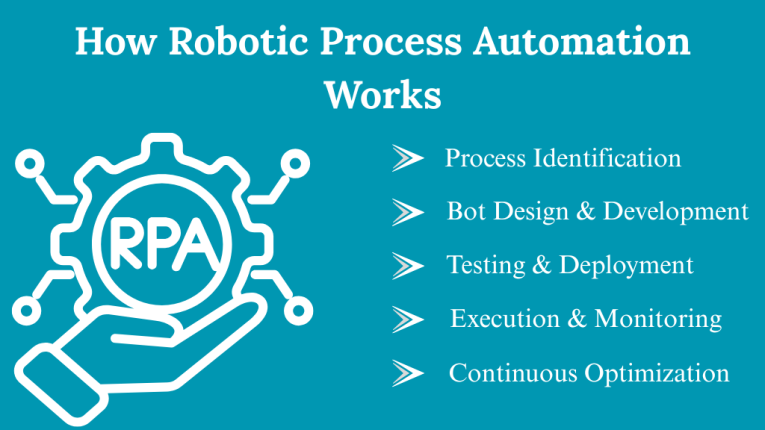
How Robotic Process Automation Works
Understanding how RPA works is essential for organizations planning to adopt automation successfully. RPA follows a structured approach to identify, design, deploy, and optimize automated workflows that improve operational efficiency.
How RPA Works: Step-by-Step Process
1. Process Identification
The first step is to identify repetitive, rule-based, and high-volume tasks that are suitable for automation. These typically include data entry, invoice processing, report generation, and transaction handling.
2. Bot Design & Development
Using specialized RPA tools, developers create software bots configured with predefined rules and workflows. These bots are programmed to replicate human actions within digital systems.
3. Testing & Deployment
Before full implementation, the automation workflow is thoroughly tested to ensure accuracy, compliance, and performance. Once validated, the bot is deployed into the live environment.
4. Execution & Monitoring
After deployment, RPA bots execute tasks automatically—24/7 if required. Performance is continuously monitored to ensure smooth operation and error handling.
5. Continuous Optimization
As business processes evolve, bots are refined and optimized to maintain efficiency, scalability, and compliance.
How Robotic Process Automation Interacts with Systems
RPA works by interacting with applications either through APIs (Application Programming Interfaces) or directly at the user interface (UI) level. Bots can log into systems, extract and validate data, process transactions, transfer information between applications, and update records—just like a human employee, but with greater speed and precision.
By automating structured workflows, Robotic Process Automation enhances productivity, minimizes errors, and supports digital transformation initiatives across industries.
How AI and RPA Combine
AI and RPA work together to create Intelligent Automation.
RPA handles structured, rule-based tasks like data entry and transaction processing, while AI adds smart capabilities such as:
- Natural Language Processing (NLP)
- Machine Learning
- Image recognition
- Decision-making
In simple terms, AI understands and analyzes unstructured data (like emails or PDFs), and RPA executes the automated workflow based on that data.
Together, they make business automation smarter, faster, and more flexible.
Examples of AI Automation in Action
Here are some real-world examples that demonstrate how AI automation and RPA integration are transforming business operations:
- Intelligent virtual assistants powered by AI handle customer inquiries 24/7, ensuring immediate responses.
- AI extracting data from invoices, while RPA processes payments automatically in accounting systems.
- Fraud detection systems in banking that analyze transaction patterns and flag suspicious activities in real time.
- AI-driven resume screening in HR departments to shortlist qualified candidates quickly.
- Automated medical record processing in healthcare for faster patient data management and diagnosis support.
These examples clearly show how combining AI and RPA enhances operational efficiency, reduces manual effort, and improves data-driven decision-making across industries.
Benefits of Robotic Process Automation
The benefits of RPA are substantial, making it a valuable investment for businesses of all sizes. By automating repetitive and rule-based processes, RPA improves efficiency, reduces costs, and enhances overall operational performance.
Key Benefits of RPA
- Increased Productivity – RPA bots operate 24/7 without fatigue, ensuring continuous task execution.
- Cost Efficiency – Reduces dependency on manual labor, lowering operational expenses.
- Higher Accuracy – Minimizes human errors and improves data reliability.
- Faster Processing – Accelerates workflows and reduces turnaround time.
- Improved Compliance – Ensures processes follow predefined rules and regulatory standards consistently.
- Scalability – Bots can be easily scaled up or down based on business requirements.
- Enhanced Customer Experience – Faster service delivery leads to improved customer satisfaction.
By implementing Robotic Process Automation, organizations can free their workforce from repetitive tasks and enable employees to focus on strategic, creative, and high-value activities that drive business growth.
Limitations of Robotic Process Automation
While Robotic Process Automation (RPA) offers numerous benefits, it also has certain limitations that businesses must consider before implementation.
Key Limitations of RPA
- Limited Decision-Making Capability – RPA is designed for rule-based tasks and cannot handle complex judgment-based decisions without AI integration.
- Dependence on Structured Processes – It works best with stable, clearly defined workflows and structured data.
- System Dependency – Changes in application interfaces or system updates may require bot reconfiguration and maintenance.
- Initial Investment Costs – Setup, licensing, and implementation expenses can be significant for some organizations.
- Lack of Human Judgment – RPA is not suitable for tasks that require emotional intelligence, creativity, or interpersonal interaction.
Understanding these limitations allows organizations to design smarter automation strategies and combine RPA with AI or human oversight where necessary for optimal results.
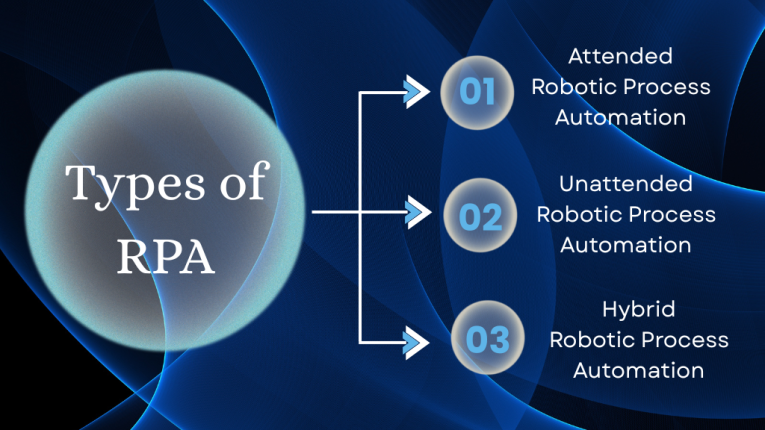
Types of Robotic Process Automation
There are three primary types of Robotic Process Automation (RPA), each designed to meet different business needs and levels of automation complexity.
1. Attended RPA
Attended RPA works alongside human employees and is typically triggered manually. These bots assist users in completing tasks more efficiently by automating specific steps within a process.
Best suited for:
- Customer service operations
- Helpdesk support
- Front-office tasks
- Real-time data validation
Attended RPA enhances employee productivity by reducing repetitive work while keeping humans in control.
2. Unattended RPA
Unattended RPA operates independently without human intervention. These bots run on servers and execute tasks automatically based on predefined schedules or triggers.
Best suited for:
- Batch processing
- Data migration
- Invoice processing
- Payroll management
- Back-office operations
Unattended RPA is ideal for high-volume, rule-based tasks that require minimal supervision.
3. Hybrid RPA
Hybrid RPA combines both attended and unattended automation. It allows seamless collaboration between humans and bots, offering greater flexibility and efficiency.
Best suited for:
- Complex workflows
- Cross-department processes
- End-to-end automation strategies
Choosing the right type of Robotic Process Automation depends on your organization’s workflow complexity, automation goals, and operational requirements. A well-planned RPA strategy ensures maximum efficiency and long-term scalability.
Common Misconceptions About RPA
Many businesses have misunderstandings about Robotic Process Automation.
Common Myths About RPA
“RPA will replace all jobs.”
In reality, RPA is designed to automate repetitive, rule-based tasks—not replace human employees. It frees up staff to focus on strategic, creative, and decision-driven responsibilities.
“RPA is only for large enterprises.”
RPA solutions are scalable and can be implemented by small and medium-sized businesses as well. Even startups can benefit from automating routine workflows.
“RPA requires advanced coding skills.”
Many modern RPA tools offer low-code or no-code platforms, making automation accessible to non-technical users and business teams.
“RPA and AI are the same.”
RPA focuses on rule-based task automation, while Artificial Intelligence (AI) adds cognitive capabilities like learning and decision-making. They are different technologies but can work together effectively.
The Reality
is not a replacement for human talent—it is a productivity enabler. When implemented strategically, RPA enhances workforce efficiency, improves accuracy, and supports business growth rather than eliminating jobs.
RPA vs. AI: Understanding the Difference
Many people confuse RPA with Artificial Intelligence (AI), but they serve different purposes in business automation. Here is a clear point-by-point comparison:
1. Core Function
RPA: Automates repetitive, rule-based tasks.
AI: Handles cognitive tasks that require learning and reasoning.
2. Type of Data
RPA: Works primarily with structured data (organized formats like spreadsheets and databases).
AI: Can process both structured and unstructured data (emails, images, voice, PDFs).
3. Learning Ability
RPA: Follows predefined rules and instructions; it does not learn on its own.
AI: Learns from data patterns and improves performance over time using Machine Learning.
4. Decision-Making Capability
RPA: Executes tasks exactly as programmed, without independent decision-making.
AI: Can analyze data, make predictions, and support intelligent decision-making.
5. Complexity Level
RPA: Best suited for simple, repetitive, high-volume processes.
AI: Designed for complex tasks involving judgment, analysis, and interpretation.
6. Business Role
RPA: Focuses on task automation and operational efficiency.
AI: Focuses on intelligence-driven automation and strategic insights.
In Simple Terms:
RPA = Task Automation
AI = Intelligent Automation
RPA + AI = Smart Digital Transformation
Both technologies are powerful individually, but when combined, they create highly efficient and intelligent automation systems for modern businesses.
Key Industries Using Robotic Process Automation (RPA)
Many industries are rapidly adopting RPA to improve efficiency and reduce operational costs.
Major Industries Using RPA:
- Banking & Financial Services – Loan processing, KYC verification, fraud monitoring.
- Healthcare – Patient records, billing, claims processing.
- Insurance – Policy management and claims automation.
- Manufacturing – Inventory and supply chain management.
- Retail & eCommerce – Order processing and customer support.
- IT & Telecom – Helpdesk automation and system monitoring.
- Government Sector – Document processing and public service operations.
RPA helps these industries enhance productivity, ensure compliance, and accelerate digital transformation.
Use Cases of Robotic Process Automation
RPA is widely used to streamline repetitive and rule-based business processes across industries.
Common Use Cases of RPA:
- Invoice Processing – Automating invoice data extraction and payment workflows.
- Payroll Management – Handling salary calculations and compliance tasks.
- Customer Onboarding – Verifying documents and updating records.
- Data Migration – Transferring data between systems accurately.
- Claims Processing – Automating insurance and reimbursement claims.
- Report Generation – Creating real-time business reports.
- Email Automation – Sorting and responding to routine emails.
- Inventory Management – Tracking stock levels and updating systems.
RPA delivers maximum value in high-volume, repetitive, and rule-based processes, helping businesses improve speed, accuracy, and efficiency.
Final Thoughts: The Future of Robotic Process Automation
Robotic Process Automation (RPA) is no longer a luxury—it has become a core driver of digital transformation. With AI integration, RPA is evolving into Intelligent Automation, capable of managing complex and data-driven workflows.
As businesses adopt automation-first strategies, understanding what RPA is, how it works, its benefits, RPA vs AI differences, and real-world use cases is essential for long-term growth.
Why Businesses Should Adopt RPA:
- Competitive advantage
- Greater operational efficiency
- Cost reduction and optimization
- Enhanced customer satisfaction
In 2026 and beyond, investing in RPA is a smart, scalable, and future-ready strategy for sustainable business success.

Leave a Comment