Tejhaksh Technologies is the Website designing & Digital Marketing company based in Neemuch, established in 2020 providing Website design, Website development, Logo design, Domain Registration, Web hosting, Android App Development, eCommerce web development, Search Engine Optimization, Bulk SMS etc. We have good experience in developing different platform websites and we keep our eye on the latest technologies to implement on the website for better conversion and user experience.
In today’s digital world, the question for many businesses isn’t whether to invest in Search Engine Optimization (SEO)—but rather, how much return that investment will generate. Search engine optimization (SEO) is one of the most powerful marketing tools for long-term business growth. But many businesses ask a crucial question—”What is the ROI of SEO?” Simply put, they want to know if the time, money, and effort spent on SEO actually yields a profitable return.
Here, we’ll explain everything you need to know about SEO ROI (Return on Investment)—from what SEO ROI actually is, why it matters, its definition, to formulas, how to measure ROI of SEO, tracking metrics, and smart strategies to maximize your SEO ROI.
The term ROI means Return on Investment. Broadly speaking, it means: how much profit you receive compared to what you spent.
When it comes to SEO (Search Engine Optimization), SEO ROI refers to the business value or revenue generated by SEO activities versus the cost of those activities. In short: “Are my SEO efforts paying off?”
ROI of SEO measures how much benefit or value your business receives from SEO compared to how much you spend on it.
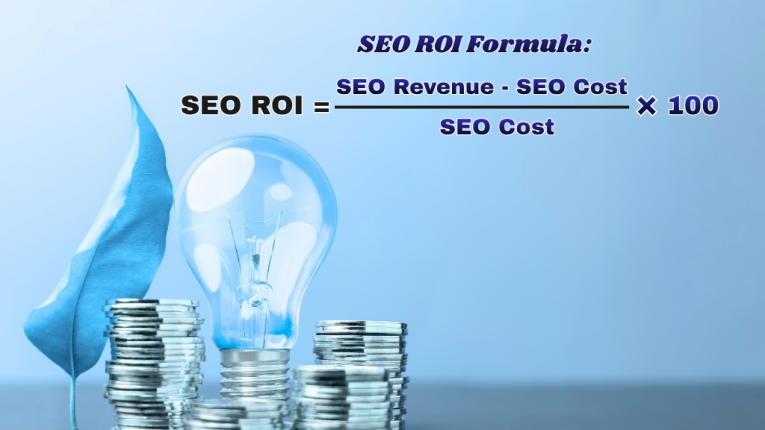
SEO ROI Formula:
SEO ROI = (SEO Revenue – SEO Cost) / SEO Cost × 100
In Simple Terms:
SEO Return on Investment = Earnings generated through SEO − Expenses incurred on SEO activities
It tells you whether your SEO strategy is effective and worth your investment. A positive ROI means your SEO is making a profit; a negative ROI means you are losing money.
Organic search is one of the largest sources of traffic for any website. In fact, most purchasing decisions these days begin with a Google search.
Since SEO plays such a crucial role in attracting visitors, it’s important to understand the financial value it brings to your business.
Here are Some Key Reasons Why SEO ROI Matters:
Let’s Explore Why Understanding ROI of SEO is Important:
When you can prove your SEO results in real numbers, it becomes easier to get more support, investment, and focus on digital growth.
Follow this simple step-by-step formula to calculate SEO ROI, which is given below:
SEO ROI (%) = [(SEO Revenue – SEO Cost) / SEO Cost] × 100
Example:
Let’s say your website earned ₹200,000 from organic search traffic in a month and your SEO spend was ₹50,000.
Now Apply the Formula:
SEO Return on Investment = [(200,000 – 50,000) / 50,000] × 100
SEO Return on Investment = (150,000 / 50,000) × 100
SEO Return on Investment = 300%
This means that for every ₹1 spent on SEO, you’re earning ₹3 in return — a great ROI!
Calculating SEO Return on Investment starts with how much revenue your SEO generates. Here’s how you can measure it:
1. Use Google Analytics
Track how many conversions (sales, leads, sign-ups) came from organic traffic.
You can find it here:
Acquisition → Channels → Organic Search.
2. Track Conversion Value
Assign a monetary value to each conversion:
For e-commerce: Use the exact purchase value.
For service businesses: Specify an average value per lead (for example, ₹1,000 per lead).
3. Set Up Goal and eCommerce Tracking
Google Analytics and Google Tag Manager help track the following:
4. Use UTM Parameters
Add UTM tags to measure traffic and conversions from specific SEO campaigns or backlinks.
SEO costs include everything you spend optimizing your site. Common cost elements include:
Add these together to get your total SEO costs.
To effectively measure Search Engine Optimization ROI, you need to track these key SEO metrics:
1. Organic Traffic
The number of visitors coming from Google and other search engines.
2. Keyword Ranking
Your position on the Google SERP for targeted keywords. Higher rankings lead to more clicks.
3. Click-Through Rate (CTR)
The percentage of people who click on your site link after seeing it in search results.
4. Conversion Rate
The percentage of organic visitors who take the desired action (purchase, sign up, etc.).
5. Customer Lifetime Value (CLV)
Your total profit from a customer over their lifetime.
6. Bounce Rate and Dwell Time
Helps you understand whether your content engages visitors.
7. Cost Per Acquisition (CPA)
How much you pay to attract each new customer using SEO.
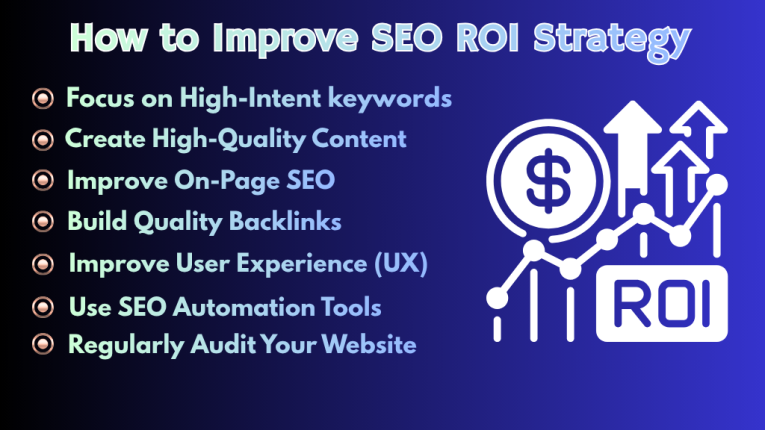
Getting a high ROI from SEO requires smart and consistent strategies. Here are the most effective strategies:
1. Focus on High-Intent keywords
Target keywords that indicate purchase or decision-making intent, such as “best SEO agency near me” or “buy running shoes online.”
2. Create High-Quality Content
SEO is content-driven. Publish informative, original, and optimized articles that solve user problems.
3. Improve On-Page SEO
Add clear titles, short meta descriptions, helpful internal links, and make sure pages load quickly.
4. Build Quality Backlinks
Links from trusted websites improve domain authority and rankings.
5. Improve User Experience (UX)
A clean, mobile-friendly, and fast website improves engagement and conversions.
6. Use SEO Automation Tools
Track rankings, analyze keywords, and monitor competitors using tools like Ahrefs, SEMrush, and Google Search Console.
7. Regularly Audit Your Website
Fix broken links, update outdated content, and improve site speed for better performance.
E-Commerce Websites
Track:
Sales from Organic Traffic
Revenue Per Transaction
Average Order Value (AOV)
Service-Based Businesses
Track:
Leads Generated from SEO
Cost Per Lead (CPL)
Lead-to-Customer Conversion Rate
Local Businesses
Track:
Calls or Visits from Google My Business
Local Keyword Ranking
Customer Reviews and Engagement
For accurate results when measuring ROI of SEO, avoid these mistakes, as outlined below:
ROI of SEO increases over time. While paid advertising stops once you stop paying, SEO continues to generate organic traffic even after your initial investment. Therefore, always measure ROI over at least 6-12 months to get a realistic picture.
ROI of SEO is one of the best indicators of your digital marketing success.
By calculating your ROI, you can clearly understand what’s working, where improvements are needed, and how much value SEO brings to your business.
Remember the Formula:
SEO ROI (%) = [(Revenue from SEO – Cost of SEO) / Cost of SEO] × 100
With the right strategy—quality content, smart keyword targeting, and regular optimization—SEO can provide the highest return on investment in digital marketing.
Leave a Comment