Tejhaksh Technologies is the Website designing & Digital Marketing company based in Neemuch, established in 2020 providing Website design, Website development, Logo design, Domain Registration, Web hosting, Android App Development, eCommerce web development, Search Engine Optimization, Bulk SMS etc. We have good experience in developing different platform websites and we keep our eye on the latest technologies to implement on the website for better conversion and user experience.
In today’s digital era, every business utilizes software to manage its operations, save time, and boost productivity. Numerous tasks—such as accounting, billing, CRM, ERP, and mobile app management—have been simplified with the aid of software. Consequently, software has become a pivotal component of any business’s growth in the modern landscape.
However, when it comes to acquiring software for a business, a crucial question arises:
Which is better for your business—custom software or off-the-shelf software?
In this blog, we will explore all these topics in simple, easy-to-understand language: what software is, its various types, how software functions, the definitions of custom versus off-the-shelf software, the main differences between custom and ready software, and which solution is more suitable for your business growth.
Software is a collection of instructions and programs that tell a computer or any digital device what tasks to perform and how to perform them. Without software, a computer’s hardware is merely a machine incapable of performing any work on its own. It is the software that enables the hardware to function effectively.
In simple terms:
Software = The Brain of a Computer System
Just as the human brain controls the body, software controls computers and other digital devices, helping them to function correctly.
Examples of Software:
In today’s world, software is being utilized in almost every field, such as:
In today’s digital landscape, it has become nearly impossible for any organization or business to operate without software. Consequently, software has emerged as a vital component of modern technology and business.
Before choosing the right software for your business, it is crucial to understand the different types of software available and where they are utilized. In simple terms, software can be broadly categorized into a few main types:
1. System Software
System software is the type of software that controls a computer’s hardware and provides a platform for other software to run.
In simple terms: It serves as the foundational system that operates the computer.
Examples:
2. Application Software
Application software is created to help users perform specific tasks or activities.
In simple terms: This is the software you use to carry out your day-to-day activities.
Examples:
3. Web Applications
Web applications are software programs that run within an internet browser and do not require separate installation.
In simple terms: These are software programs that operate online.
Examples:
4. Mobile Applications
Mobile applications (apps) are software programs that are designed to work on smartphones and tablets
In simple terms: These are the apps used on mobile devices.
Examples:
Software functions by processing input provided by the user and executing instructions written in programming languages. In other words, software is pre-programmed to know exactly what action to take in any given situation, and it repeatedly follows those specific instructions.
Simply put:
The operational workflow of software follows this pattern:
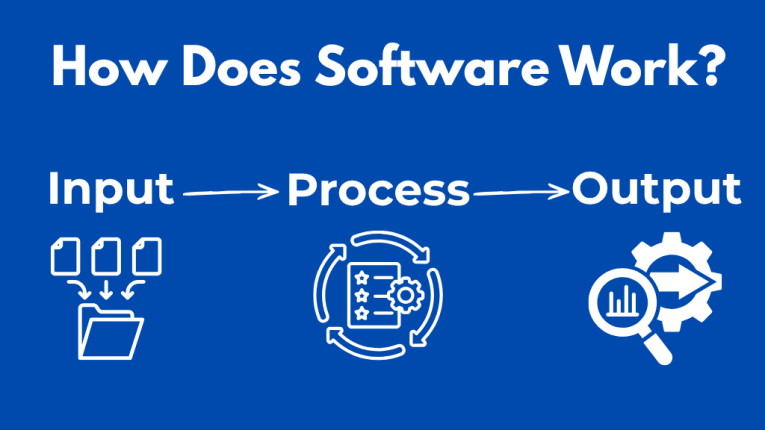
Input → Process → Output
1. The user provides input.
For example: data, names, numbers, product details, etc.
2. The software processes the input.
The software performs calculations or processes the data in accordance with its internal programs and rules.
3. Output is generated.
Following the processing stage, the software displays the result.
Let’s understand this with an example:
Suppose you are using Billing Software:
1. Code (Programming Code)
This constitutes the core of the software. The software operates precisely according to the instructions written by the developers.
2. Database
This is where the software’s data is stored—such as customer details, product information, billing records, etc.
3. Server (For Web Apps)
Software applications that operate over the internet (such as websites or web apps) function with the assistance of servers.
Also read this:
What is Microsoft SQL Server? Features, History, Uses & Versions Explained
What are HTTP Status Codes? Types, Meaning & Their Impact on Website SEO
What Is Blockchain Technology? It’s Types, How Does It Work and How to Use It?
What is Microsoft Azure? Complete Guide for Beginners (Features, Uses & Benefits)
Custom software is software that is specifically designed and developed to meet the unique needs of a particular business, company, or organization. Unlike off-the-shelf software—which is designed for the general public—custom software is created for a specific company or a specific task.
In simple terms:
Custom Software = Software built according to a business’s specific needs.
Every business operates differently; consequently, off-the-shelf software often fails to meet all requirements completely. In such situations, custom software is developed to ensure that the software functions in perfect alignment with the business’s specific processes.
Examples of Custom Software:
1. Aligns perfectly with business operations
Since the software is built to mirror the business’s entire workflow, tasks become easier to manage.
2. Boosts Efficiency and Productivity
When software is perfectly tailored to the work at hand, it saves time and accelerates task completion.
3. Enhanced Security
Data remains more secure within custom software because it is not a publicly available application.
4. Scalability
As the business expands, new features and functionalities can be added to the software.
5.Long-Term Value
While the initial investment may be higher, custom software proves to be significantly more beneficial for the business in the long run.
Ready software refers to software that is pre-built and available in the market for general use. It is also known as “Off-the-Shelf Software.” You can begin using this type of software immediately—either by purchasing it directly or by subscribing to it—without the need to have it developed specifically for your needs.
In simple terms:
Ready Software = Pre-built software that can be used instantly.
This software is designed with common business requirements in mind; consequently, it is widely utilized by small and medium-sized businesses.
Examples of Ready Software:
1. Cost-Effective (Low Cost)
It is less expensive compared to custom-developed software.
2. Easy to Use
Since the software is pre-designed, it is intuitive and easy to operate.
3. Time-Saving
It requires no development time; you can start using it right away.
4. Updates and Support
The software vendor provides periodic updates and security patches.
5. Pre-tested
Because this software is used by a large number of people, it is thoroughly tested and stable.
When a business requires software, the biggest question that arises is whether to commission custom software or purchase a ready-made solution. Both options have their own distinct advantages and limitations. Therefore, it is crucial to select the right choice based on your business’s specific needs, budget, and timeline.
Let’s understand the differences between the two in simple terms:
1. Cost
Conclusion: If the budget is limited, ready-made software is the better choice; however, if you require software for the long term, custom software is an excellent option.
2. Customization
Conclusion: If your business has unique or distinct requirements, custom software would be the superior choice.
3. Scalability
Conclusion: Custom software proves to be more beneficial for long-term use.
4. Implementation Time
Conclusion: If you require software immediately, ready-made software is the right choice.
5. Security
Conclusion: Custom software is the better option for businesses handling sensitive data.
6. Maintenance
Simple Conclusion:
Therefore, which software is better depends entirely on your business’s specific needs.
There is no single definitive answer as to whether custom software or off-the-shelf software is superior, as the choice depends entirely on your business’s specific needs, budget, and operational workflow. Both types of software offer distinct advantages; therefore, the right choice should be made based on your unique circumstances.
Simply put:
If your operations are unique and large-scale, custom software is the better choice; however, if your operations are standard and your budget is limited, off-the-shelf software is preferable.
You should choose custom software if:
Examples:
Large enterprises, manufacturing businesses, school management systems, hospital management systems, ERP systems, etc.
You should choose off-the-shelf software if:
Examples:
Small businesses, retail shops, accounting and billing systems, basic CRM tools, etc.
Maintaining high software quality is crucial to ensure that it functions correctly without any issues and provides a superior user experience. If the software quality is high, business operations will also proceed more rapidly and smoothly.
Simple Ways to Maintain Software Quality:
1. Regular Updates
Keep the software updated periodically to access new features and ensure continued security.
2. Thorough Testing (QA & Testing)
Conduct rigorous testing of the software—both before and after launch—to minimize errors.
3. Bug Fixing and Maintenance
If any issues or bugs arise in the software, fix them immediately and perform regular maintenance.
4. Data Backup and Security
Keep your data secure and perform periodic backups to eliminate the risk of data loss.
5. Improve Performance (Optimization)
Focus on the software’s speed and performance to ensure it runs quickly and smoothly.
6. Gather User Feedback and Iterate
Continuously improve the software based on user feedback and suggestions.
Both custom software and off-the-shelf software are useful in their own respective ways. Which of these options is right for you depends entirely on your business’s specific needs, budget, and future plans.
If your business has unique requirements and you seek a solution that grows with you over the long term, is secure, and is perfectly tailored to your workflow, then custom software will prove to be the superior choice for you. Conversely, if you require a simple, ready-made solution to get started quickly and at a lower cost, then off-the-shelf software would be the right fit.
Ultimately, selecting the right software plays a pivotal role in the success of your business. Therefore, before making a decision, thoroughly understand your requirements and choose the appropriate option accordingly, so that you can elevate your business’s efficiency, productivity, and growth to new heights.
Leave a Comment