

- October 15, 2026
- Tejhaksh
- 0 Comments
- Uncategorized, Website Security
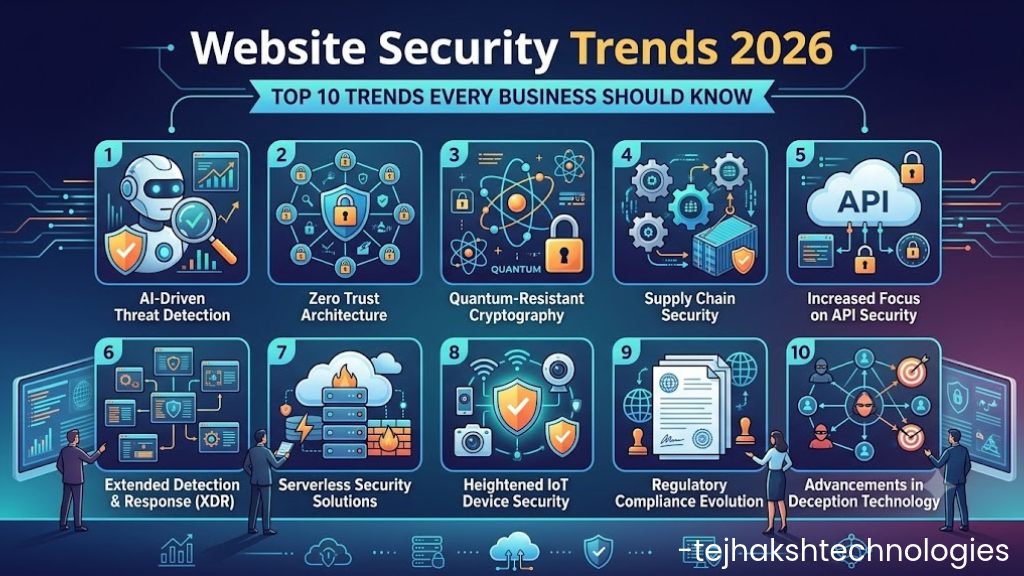
Website Security Trends 2026: Top 10 Trends Every Business Should Know
Website security has become a critical priority for businesses, developers, e-commerce platforms, and website owners in 2026. As organizations increasingly depend on digital platforms to connect with customers, manage information, and deliver online services, protecting websites against cyberattacks is more important than ever.
Modern cyber threats are becoming increasingly sophisticated. Attackers may use automated tools, artificial intelligence (AI), stolen credentials, malicious scripts, and software vulnerabilities to compromise websites. A single security incident can lead to data theft, financial losses, service interruptions, and damage to a company’s reputation.
Understanding the latest website security trends in 2026 can help businesses strengthen their digital infrastructure and protect sensitive information. From AI-powered threat detection to Zero Trust security, cloud-based protection, and automated vulnerability scanning, modern security technologies are changing how organizations defend their websites.
In this guide, we will explore the top 10 website security trends, explain what website security means, discuss common web security threats, and introduce essential website security tools and technologies.
What Is Website Security?
Website security refers to the practices, technologies, and processes used to protect websites and web applications from cyberattacks, unauthorized access, malware, data theft, and other online threats.
The primary purpose of website security is to maintain the confidentiality, integrity, and availability of a website and its information. These principles help ensure that sensitive data remains protected, website content cannot be changed by unauthorized users, and legitimate visitors can access online services.
Website security includes several important measures, such as:
- Installing and maintaining SSL/TLS certificates.
- Using strong passwords and multi-factor authentication.
- Keeping website software, plugins, and frameworks updated.
- Protecting web applications against common vulnerabilities.
- Monitoring website traffic for suspicious activity.
- Creating regular backups and testing recovery procedures.
- Using firewalls and malware detection tools.
- Applying appropriate access controls to administrative accounts.
For example, an e-commerce website processes customer information, account credentials, and payment-related data. Without proper website security, attackers may exploit vulnerabilities to access accounts, inject malicious code, or disrupt transactions.
Effective web security is not a one-time task. It requires continuous monitoring, regular updates, security testing, and a clear plan for responding to incidents.

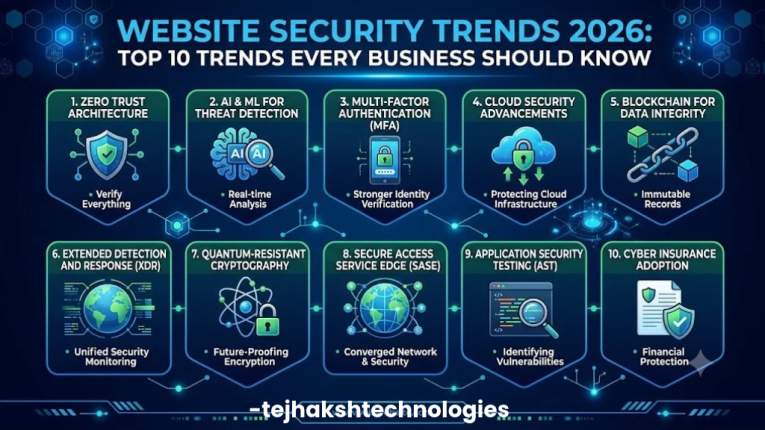
Website Security Trends 2026: Top 10 Trends Every Business Should Know
1. AI-Powered Website Security
Artificial intelligence is reshaping cybersecurity by helping businesses strengthen their website protection strategies. AI-driven security solutions can process network traffic, recognize unusual patterns, and alert security teams to potential threats before they cause significant damage.
Unlike conventional security tools that mainly rely on predefined rules and previously identified attack signatures, AI-based systems can assess behavioral patterns to uncover suspicious activities. These may include repeated failed login attempts, unexpected increases in website traffic, unusual access requests, or sudden changes in user behavior.
Businesses can use AI-assisted security tools for:
- Detecting suspicious login activity.
- Identifying potentially malicious website traffic.
- Supporting automated security alerts.
- Prioritizing vulnerabilities for investigation.
- Helping security teams analyze incidents.
AI cannot replace human expertise and may miss threats or generate false alerts. Businesses should combine AI detection with expert review, strong security measures, and effective incident response.
In 2026, organizations should evaluate AI security features based on their accuracy, transparency, privacy safeguards, and ability to integrate with existing security systems.
2. Zero Trust Security Architecture
Zero Trust is a security approach based on the principle that access should never be granted automatically simply because a user or device is inside an organization’s network.
Instead, every access request should be evaluated according to factors such as identity, permissions, device security, and the sensitivity of the requested resource.
Zero Trust security can help businesses reduce the risks associated with compromised accounts and unauthorized access.
Important Zero Trust practices include:
- Verifying user identities before granting access.
- Applying least-privilege access permissions.
- Requiring multi-factor authentication for sensitive accounts.
- Monitoring access to important systems.
- Reviewing and removing unnecessary permissions.
- Separating critical systems to limit the impact of a breach.
For example, a website administrator should receive only the permissions required to perform their responsibilities. If an account is compromised, restricted permissions can reduce the attacker’s ability to access other systems.
Zero Trust is particularly valuable for businesses using cloud platforms, remote teams, third-party services, and multiple web applications.
3. Advanced Web Application Firewalls
A Web Application Firewall (WAF) helps protect websites and web applications by inspecting HTTP and HTTPS requests and filtering traffic according to security rules.
A WAF can help identify and block various malicious requests, including some SQL injection attempts, cross-site scripting attacks, and suspicious automated traffic.
Modern WAF solutions may include managed rule sets, behavioral analysis, bot protection, and automated rule updates.
Businesses can deploy a WAF as a cloud service, through a hosting or security provider, or as part of their own infrastructure.
The benefits of a WAF include:
- Filtering potentially malicious web requests.
- Reducing exposure to common web application attacks.
- Supporting virtual patching for certain known vulnerabilities.
- Helping manage traffic during suspicious activity.
- Providing security logs for investigation.
However, a WAF cannot fix every underlying software vulnerability. Secure coding, patch management, authentication controls, and application testing remain essential.
Organizations should review WAF logs regularly and configure security rules to avoid blocking legitimate users.
4. Automated Vulnerability Scanning
Automated vulnerability scanning is becoming an essential part of website security management. Scanning tools help identify potential weaknesses in websites, web applications, servers, dependencies, and configurations.
Examples of issues a scanner may detect include outdated software, exposed services, insecure configuration settings, and known vulnerabilities in supported components.
Businesses can use several types of security testing:
- Dynamic Application Security Testing (DAST): Tests a running application for potential security weaknesses.
- Static Application Security Testing (SAST): Analyzes an application’s source code to detect potential security vulnerabilities before the software is deployed.
- Software Composition Analysis (SCA): Identifies vulnerable third-party libraries and dependencies.
- Configuration scanning: Checks systems for insecure settings and missing protections.
Automated scanning helps teams discover issues earlier and prioritize remediation according to severity and business impact.
Nevertheless, scanning tools may miss vulnerabilities or report issues that require manual verification. Organizations should combine automated testing with code reviews, penetration testing where appropriate, and regular remediation.
Scan only systems you own or are authorized to test.
5. Cloud-Based Website Security
Cloud computing allows businesses to run websites, manage data, and provide online services through scalable infrastructure. However, securing cloud environments requires proper access controls, safe configurations, data encryption, and continuous monitoring.
Cloud security solutions help protect websites through centralized threat monitoring, malicious traffic filtering, scalable defenses, and advanced security management.
Important cloud security practices include:
- Enforcing multi-factor authentication for cloud administrators.
- Restricting access to storage and databases.
- Encrypting sensitive information in transit and at rest.
- Monitoring configuration changes and administrative activity.
- Protecting application programming interfaces (APIs).
- Maintaining tested backups and recovery procedures.
Misconfigured storage, excessive permissions, exposed credentials, and unprotected services can create serious risks.
Businesses should follow the shared responsibility model provided by their cloud service provider. The provider may secure the underlying infrastructure, while the customer remains responsible for many application, identity, data, and configuration controls.
A strong cloud security plan strengthens business protection while ensuring that cloud hosting alone is never mistaken for complete website security.
6. Stronger Authentication and Passwordless Login
Stolen or reused passwords remain a significant security risk for websites. Attackers may use phishing, credential stuffing, or automated login attempts to gain unauthorized access to user and administrator accounts.
In 2026, businesses should prioritize stronger authentication methods and reduce their dependence on passwords alone.
Recommended authentication measures include:
- Multi-factor authentication (MFA).
- Passkeys based on public-key cryptography.
- Rate limiting for login attempts.
- Secure account recovery procedures.
- Monitoring unusual login locations or behavior.
- Password managers and compromised-password checks.
Passkeys can reduce exposure to phishing compared with traditional passwords when implemented correctly. They allow users to authenticate using cryptographic credentials, often with a device’s biometric or PIN-based verification.
Businesses should also secure administrative accounts separately from ordinary user accounts. Sensitive actions, such as changing payment settings or modifying user permissions, may require additional verification.
Authentication should be combined with secure session management, appropriate access controls, and protection against account-recovery abuse.
7. API Security and Protection of Web Services
Application programming interfaces (APIs) allow websites, mobile applications, payment services, and third-party platforms to exchange data. As businesses rely more heavily on connected services, API security has become a key part of website protection.
An insecure API may expose sensitive information, allow unauthorized actions, or provide attackers with a route into connected systems.
Common API security risks include broken authorization, weak authentication, excessive data exposure, insufficient rate limiting, and improper input validation.
Businesses can improve API security by:
- Requiring appropriate authentication and authorization.
- Checking access permissions for individual records and operations.
- Validating incoming data.
- Limiting request rates and resource consumption.
- Avoiding the exposure of unnecessary sensitive information.
- Monitoring API usage for abnormal patterns.
- Maintaining an inventory of active API endpoints.
Developers should also protect API credentials, rotate secrets when necessary, and avoid embedding sensitive keys in publicly accessible client-side code.
API security testing should be included throughout the software development lifecycle rather than being postponed until an application is deployed.
8. Supply Chain and Third-Party Dependency Security
Modern websites frequently depend on open-source libraries, content management systems, plugins, themes, analytics scripts, payment integrations, and external services.
These dependencies save development time, but a vulnerability in one component can affect many websites that rely on it.
Supply chain security focuses on identifying, evaluating, and managing risks associated with software components and external providers.
Useful practices include:
- Updating plugins, frameworks, and libraries regularly.
- Removing unused extensions and dependencies.
- Monitoring security advisories.
- Using trusted software repositories and maintainers.
- Reviewing third-party access permissions.
- Verifying the integrity of downloaded software.
- Maintaining an inventory of software components.
Businesses should avoid installing plugins or scripts from unknown sources simply because they offer convenient features.
A software bill of materials (SBOM) can help organizations document the components included in an application. This information can make it easier to identify affected dependencies when a vulnerability is disclosed.
Supply chain security is particularly important for websites built on content management systems and applications that rely on numerous external packages.
9. Bot Management and DDoS Protection
Not all automated website traffic is malicious. Search engine crawlers, monitoring services, and other legitimate bots perform useful functions. However, malicious bots can scrape content, test stolen credentials, submit spam, abuse APIs, and consume server resources.
Distributed Denial-of-Service (DDoS) attacks attempt to overwhelm a website or its supporting infrastructure with traffic or requests, making services slow or unavailable.
Modern bot management and DDoS protection technologies help businesses distinguish legitimate activity from suspicious traffic.
Protection methods include:
- Traffic rate limiting.
- Network-level and application-level DDoS mitigation.
- Bot detection and behavioral analysis.
- Web application firewall rules.
- Caching and content delivery networks (CDNs).
- Monitoring traffic spikes and unusual request patterns.
Businesses should choose controls based on the type of website, expected traffic, and risk profile. For example, an online store may need stronger protection against account abuse and checkout automation, while a content website may focus on scraping and traffic availability.
No single solution prevents every attack. A layered defense that combines infrastructure protection, application controls, monitoring, and incident-response planning is more effective.
10. Continuous Security Monitoring and Incident Response
Website security does not end after a website is launched. New vulnerabilities are discovered, software changes, user permissions evolve, and attack techniques continue to develop.
Continuous security monitoring helps businesses detect suspicious activity and investigate potential incidents before they cause greater damage.
Useful monitoring activities include:
- Reviewing authentication and administrator logs.
- Tracking unexpected file modifications.
- Monitoring server errors and unusual traffic.
- Detecting suspicious database activity.
- Reviewing vulnerability scan results.
- Alerting teams about critical security events.
- Testing backup restoration and incident-response procedures.
Businesses should create a documented incident-response plan that identifies responsibilities, escalation procedures, communication methods, and recovery steps.
Regular backups are particularly important, but backups should be protected from unauthorized modification and tested to confirm that data can actually be restored.
Continuous monitoring, regular security assessments, and rehearsed recovery procedures help organizations improve their ability to withstand and recover from security incidents.
Common Web Security Threats in 2026
Understanding common web security threats helps businesses choose appropriate protection methods. The following threats affect websites and web applications in different ways.
SQL Injection
SQL injection occurs when an application handles untrusted input in a way that allows an attacker to interfere with database queries.
Depending on the vulnerability and database permissions, this may expose information or allow unauthorized changes.
Prevention: Use parameterized queries, safe database APIs, input validation, and least-privilege database accounts.
Cross-Site Scripting (XSS)
Cross-site scripting occurs when an application allows malicious scripts to execute in another user’s browser.
Such attacks may compromise sessions, manipulate page content, or deceive visitors.
Prevention: Apply context-aware output encoding, safe rendering methods, appropriate input handling, and a well-configured Content Security Policy (CSP).
Malware and Website Defacement
Attackers may inject malicious code, upload harmful files, or modify website content after exploiting a vulnerability or compromised account.
Prevention: Keep software updated, restrict administrative access, scan for suspicious changes, and maintain clean, tested backups.
DDoS Attacks
DDoS attacks overwhelm a website or its infrastructure with excessive traffic or requests.
Prevention: Use suitable DDoS mitigation services, rate limiting, CDN capabilities, and infrastructure monitoring.
Phishing and Account Compromise
Phishing attempts trick users into revealing credentials or approving unauthorized access. Compromised administrator accounts can give attackers significant control over a website.
Prevention: Enable MFA or passkeys, train staff to recognize phishing, secure account recovery, and monitor suspicious logins.
Broken Access Control
Broken access control occurs when an application fails to enforce the permissions required to access data or perform an action.
For example, a user might access another customer’s records if the server checks authentication but fails to verify ownership.
Prevention: Enforce authorization on the server for every sensitive operation and test permissions across different user roles.
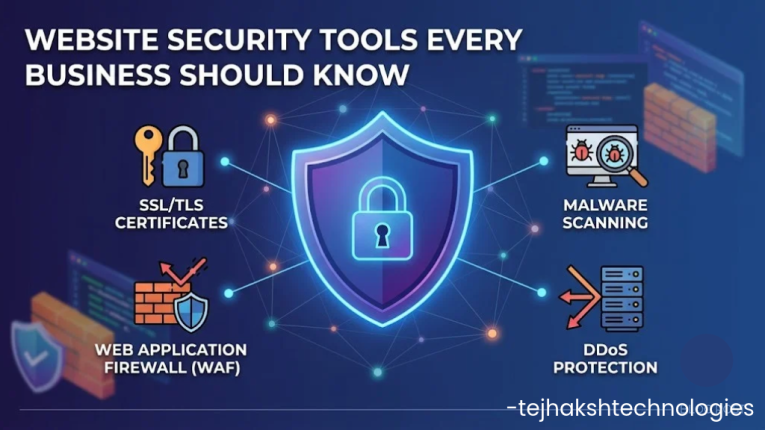
Website Security Tools Every Business Should Know
Web security tools help organizations identify vulnerabilities, monitor suspicious behavior, and protect applications from common attacks. The right tools depend on the website’s platform, complexity, budget, and risk level.
1. Web Application Firewalls
WAF tools filter potentially malicious HTTP and HTTPS traffic before it reaches an application. They are useful for reducing exposure to common web attacks and managing suspicious requests.
2. Vulnerability Scanners
Vulnerability scanners check websites, servers, applications, and dependencies for known weaknesses or insecure configurations. Results should be reviewed and prioritized before remediation.
3. Malware Detection Tools
Website malware scanners look for known malicious code, suspicious files, and other indicators of compromise. They are particularly useful for websites that use content management systems or accept file uploads.
4. SSL/TLS Testing Tools
SSL/TLS testing tools help administrators assess certificate validity and identify weaknesses in HTTPS configuration. A valid certificate protects data in transit but does not, by itself, make the entire website secure.
5. Security Monitoring and Logging Tools
Monitoring platforms collect logs, generate alerts, and help teams investigate unusual activity. Larger organizations may use Security Information and Event Management (SIEM) systems to analyze events across multiple systems.
6. Code and Dependency Scanning Tools
SAST and SCA tools help developers identify potential security problems in source code and third-party dependencies. Integrating these checks into development workflows can help detect issues before deployment.
When choosing website security tools, consider accuracy, ease of use, platform compatibility, reporting features, update frequency, and the support available for investigating findings.
Essential Technologies for Web Security
Modern web security relies on multiple technologies working together. Each technology addresses a different part of the security problem.
SSL/TLS Encryption
SSL/TLS certificates enable HTTPS connections and help protect information transmitted between a visitor’s browser and a website. Proper certificate management helps prevent common connection-security problems.
Multi-Factor Authentication
MFA requires additional verification beyond a password, making unauthorized access more difficult when credentials are stolen.
Content Security Policy
CSP is a browser security mechanism that allows web operators to restrict the sources from which certain content can load. A carefully configured policy can reduce the impact of some script-injection attacks.
Web Application Firewall
A WAF inspects web requests and applies rules to block or challenge suspicious traffic. It works alongside application-level security rather than replacing secure development.
Endpoint Detection and Response
Endpoint Detection and Response (EDR) technologies monitor supported computers and servers for suspicious activity. They can help detect compromise on systems used to manage or host websites.
Security Information and Event Management
SIEM platforms collect and correlate security logs from different systems. They can help security teams identify patterns that might be difficult to notice when reviewing individual logs.
Secure Software Development
Secure software development involves identifying potential risks, reviewing code, testing for vulnerabilities, managing third-party components, and deploying updates safely. Addressing security concerns early in the development process can help prevent costly fixes and reduce future risks.
Using multiple security technologies together creates a stronger defense for websites. Since every tool has limitations, a combination of protective measures is essential for managing different types of cyber threats.
Web Security Best Practices for Businesses in 2026
Businesses can improve their web security by following a structured approach.
- Keep software updated: Apply security patches to content management systems, plugins, frameworks, operating systems, and server software.
- Use strong authentication: Enable MFA or passkeys for administrators and other sensitive accounts.
- Encrypt website traffic: Configure HTTPS correctly and renew certificates before they expire.
- Restrict access: Give users only the permissions they need to perform their tasks.
- Scan for vulnerabilities: Perform regular, authorized security assessments and address critical findings promptly.
- Protect databases: Use parameterized queries, restricted database accounts, and secure connection settings.
- Monitor website activity: Review logs, configure alerts, and investigate unexpected changes.
- Create secure backups: Keep protected backups and test restoration procedures regularly.
- Protect APIs and integrations: Validate requests, enforce authorization, and remove unused endpoints.
- Prepare for incidents: Document response procedures and test how the business will restore essential services.
Businesses should prioritize controls based on their specific threats, data sensitivity, and operational requirements. A small informational website and a large financial platform will not need identical security arrangements.
The Future of Website Security Beyond 2026
Website security will continue to evolve as businesses adopt new technologies and attackers develop new techniques.
AI-assisted security operations may help teams analyze incidents faster, while automated testing can improve vulnerability discovery during software development. Passkeys and stronger identity controls may reduce reliance on vulnerable password-based authentication.
At the same time, growing dependence on APIs, cloud infrastructure, third-party software, and interconnected applications will require organizations to pay closer attention to access permissions and software supply chain risks.
Businesses should focus on adaptable security practices instead of relying on a single product or trend. Regular assessments, secure development, reliable monitoring, employee awareness, and tested recovery procedures will remain important even as specific tools change.
Conclusion
Web security trends in 2026 highlight the importance of proactive, layered, and continuously maintained protection. AI-assisted threat detection, Zero Trust architecture, advanced WAF solutions, automated vulnerability scanning, cloud security, stronger authentication, API protection, supply chain security, bot management, and continuous monitoring all contribute to a stronger security posture.
However, adopting new technologies is only one part of the solution. Businesses must also maintain their software, enforce appropriate access controls, protect sensitive information, test their applications, and prepare for security incidents.
Whether you operate a small business website, an e-commerce store, or a complex web application, investing in web security can help reduce risk and protect customer trust.
Start by reviewing your current security controls, identifying your most important vulnerabilities, and creating a practical improvement plan. A consistent security strategy can help your business adapt to emerging threats and maintain a more resilient online presence.
Leave a Comment