
Tejhaksh Technologies is the Website designing & Digital Marketing company based in Neemuch, established in 2020 providing Website design, Website development, Logo design, Domain Registration, Web hosting, Android App Development, eCommerce web development, Search Engine Optimization, Bulk SMS etc. We have good experience in developing different platform websites and we keep our eye on the latest technologies to implement on the website for better conversion and user experience.
In today’s rapidly evolving digital era, every company is seeking new ways to enhance efficiency, reduce costs, and maintain a competitive edge in the market. An emerging technology playing a pivotal role in this endeavor is Hyperautomation, which is rapidly accelerating the pace of digital transformation.
Hyperautomation represents a step beyond traditional automation, as it integrates various advanced technologies—such as AI (Artificial Intelligence), RPA (Robotic Process Automation), and Machine Learning—to seamlessly automate even the most complex business processes.
Simply put, Hyperautomation means intelligently automating every process wherever feasible. It is not limited merely to automating small, isolated tasks; rather, it focuses on automating entire workflows from end to end. This enables companies to make their operations faster, simpler, and more effective, while simultaneously delivering superior experiences to their customers.
In this SEO-friendly guide, we will explore all the key aspects of Hyperautomation in simple, easy-to-understand language, covering topics such as:
What Hyperautomation is
How Hyperautomation works
Hyperautomation vs. Automation vs. RPA
The benefits of Hyperautomation
Its real-life use cases
Potential challenges and risks
Simple steps for implementing Hyperautomation
If you are looking to digitally advance your business, this guide will prove to be an invaluable resource for you.
Hyperautomation is a modern technology that utilizes various advanced technologies to automate business tasks. It primarily involves:
Simply put, Hyperautomation means—automating as many tasks as possible, in the smartest way possible.
While traditional automation is limited to a few specific and repetitive tasks, Hyperautomation focuses on automating entire business processes and workflows from end to end.
This enables companies to:
Overall, Hyperautomation helps make businesses smarter, faster, and more effective.
In today’s digital and competitive landscape, Hyperautomation is becoming increasingly vital for businesses, as it makes operations faster, simpler, and more effective.
With the help of Hyperautomation, companies can:
In today’s competitive market, companies that embrace Hyperautomation are able to execute their operations in a smarter, faster, and more precise manner—thereby gaining a competitive edge over others.
Hyperautomation combines various modern technologies to create a smart and fully automated system (ecosystem), enabling business operations to be completed rapidly and without interruption.
The Fundamental Process:
An Illustrative Example:
In this way, Hyperautomation creates a smart system that requires minimal human intervention, ensuring that tasks are completed both rapidly and accurately.
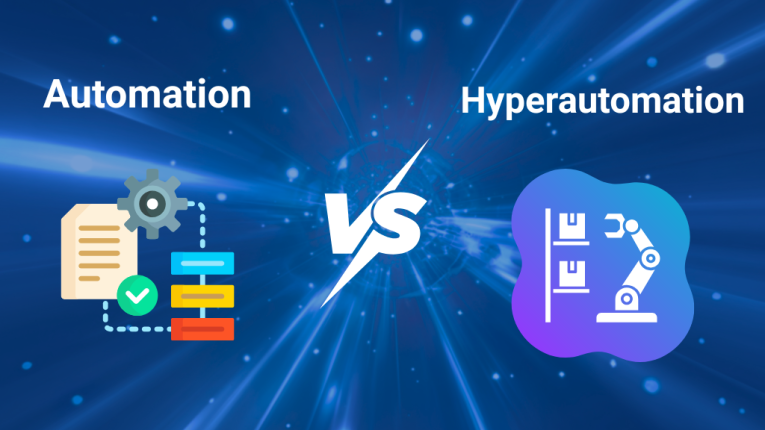
Key Differences Between Automation and Hyperautomation:
Automation
Hyperautomation
Key Distinction:
Hyperautomation vs. RPA (Robotic Process Automation)
Understand the difference between these two technologies in simple terms:
RPA (Robotic Process Automation)
Hyperautomation
Key Difference:
RPA (Robotic Process Automation) is a modern technology that utilizes software bots to automatically execute repetitive and rule-based tasks performed on a computer. Simply put, RPA operates as if a human were working on the computer, yet it performs these tasks with greater speed, precision, and without errors. It is employed for tasks such as data entry, form filling, report generation, sending emails, and file management. With the aid of RPA, companies can save both time and costs, minimize human errors, and operate continuously 24/7—thereby significantly enhancing their operational efficiency.
Hyperautomation brings several significant benefits to businesses, making operations easier, faster, and more effective.
1. Increased Efficiency
By automating repetitive tasks, it accelerates overall workflow speed and saves time.
2. Cost Reduction
Reducing manual labor lowers operational costs and makes the business more cost-effective.
3. Improved Accuracy
Human errors in data processing are minimized, resulting in work that is more accurate and reliable.
4. Enhanced Decision-Making
With the aid of AI and data analytics, companies can make faster and more accurate decisions.
5. Scalability
As the business grows, Hyperautomation can easily scale up to match that growth.
6. Improved Customer Experience
Quicker service and prompt responses help improve overall customer satisfaction and experience.
7. Enhanced Productivity
Employees can focus on critical and creative tasks rather than on mundane, routine chores.
Overall, Hyperautomation helps make businesses faster, more accurate, and more productive.
While Hyperautomation offers numerous benefits, implementing it can also present certain challenges. Let’s understand them in simple terms:
1. High Initial Costs
Hyperautomation utilizes advanced technologies (such as AI, RPA, etc.); consequently, the upfront investment required to initiate it can be substantial.
2. Process Complexity
It involves integrating various tools and systems, which can render the overall infrastructure somewhat complex.
3. Skill Shortage
Properly managing Hyperautomation requires trained and skilled professionals, who are not always readily available everywhere.
4. Data Security Concerns
Given the extensive use of large volumes of data, ensuring robust data security is absolutely critical.
5. Difficulty in Adopting Change
Some employees may feel hesitant to embrace new technologies, which can potentially lead to disruptions in workflow.
Keep in Mind:
To mitigate these challenges and risks, it is essential to develop a sound plan, select the right tools, and formulate an effective strategy.
Hyperautomation is currently being utilized across various industries, making work faster, easier, and smarter. Let’s explore some of its key applications in simple terms:
1. Banking and Finance
2. Healthcare
3. E-commerce
4. Manufacturing
5. IT and Software
Overall, Hyperautomation helps make work faster, more accurate, and more effective across every industry.
To implement Hyperautomation effectively, it is essential to adopt a simple and systematic process. By following the steps outlined below, you can successfully implement it:
Step 1: Identify Automation Opportunities
First, identify tasks that are repetitive and time-consuming. Such tasks are the most suitable candidates for automation.
Step 2: Define Goals
Determine exactly what you wish to achieve—such as reducing costs, saving time, or increasing operational speed.
Step 3: Select the Right Tools
Choose the appropriate tools for your specific needs, such as RPA, AI, Machine Learning, or BPM platforms.
Step 4: Develop a Strategy
Create a clear plan outlining how and in what sequence the automation will be implemented.
Step 5: Test and Deploy
Rather than deploying directly across the entire system, conduct a test on a small scale (a pilot project) first, and then gradually roll it out fully.
Step 6: Monitor and Refine
Once the automation is implemented, monitor its performance closely and continue to make improvements as needed.
Hyperautomation is a modern and powerful approach that combines technologies such as AI, Machine Learning, and RPA to go far beyond traditional automation. It helps businesses simplify complex tasks, enhance efficiency, and reduce costs.
While it does present certain challenges and risks, when implemented with proper planning and the right methodologies, its benefits far outweigh these difficulties.
In today’s digital and competitive landscape, adopting Hyperautomation has become essential if you wish to drive your business forward.
So, do not delay—get started with Hyperautomation today and make your business faster, smarter, and future-ready.
Leave a Comment