Tejhaksh Technologies is the Website designing & Digital Marketing company based in Neemuch, established in 2020 providing Website design, Website development, Logo design, Domain Registration, Web hosting, Android App Development, eCommerce web development, Search Engine Optimization, Bulk SMS etc. We have good experience in developing different platform websites and we keep our eye on the latest technologies to implement on the website for better conversion and user experience.
In today’s digital age, having a fast, smooth, and user-friendly website is no longer just an option; it has become a fundamental necessity for every business. Amidst increasing online competition, good design and quality content alone are not enough—your website’s speed, stability, and overall performance are equally critical. This is precisely where Core Web Vitals play a pivotal role in determining your website’s success.
If you aim to boost your website’s loading speed, improve your Google rankings, and enhance the user experience, then understanding Core Web Vitals—and optimizing them correctly—has become absolutely essential in 2026.
In this comprehensive guide, you will discover:
If you want to make your website fast, SEO-friendly, and high-performing, this guide will prove to be an invaluable resource for you.
Core Web Vitals are a set of key performance metrics defined by Google, used to measure a website’s Real User Experience. These metrics indicate how fast, responsive, and stable your website is for its users.
They primarily focus on three critical aspects:
Simply put, Core Web Vitals determine how fast, smooth, and seamless an experience your website delivers to users—and this is precisely what makes a significant difference in Google rankings.
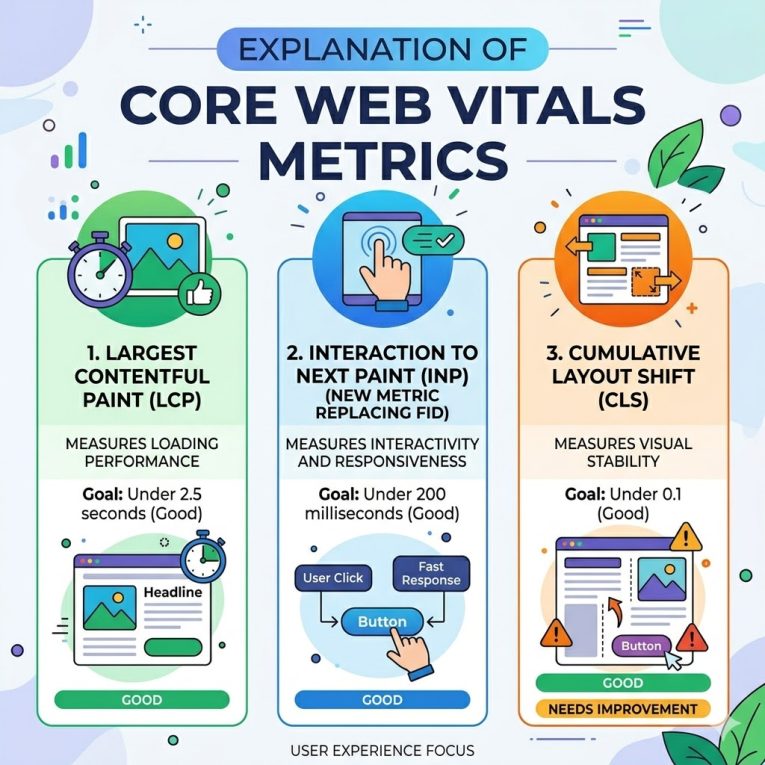
Core Web Vitals consists of three key metrics that are absolutely essential to focus on. These metrics evaluate how fast your website loads, how quickly it responds to user actions, and how stable the layout remains during loading.
LCP (Largest Contentful Paint) indicates how long it takes for the largest and most significant content on your webpage—such as an image, banner, or heading—to become visible to the user.
In simple terms:
LCP measures the moment when the user perceives your page as being “mostly loaded.”
LCP Thresholds:
Fast LCP = Fast Loading Experience = Better User Experience + Higher SEO Rankings
Therefore, if you wish to improve your website’s performance and Google rankings, optimizing LCP is the most critical step.
INP (Interaction to Next Paint) measures how quickly a page visually responds when a user performs an action on your website—such as a click, tap, or keyboard input.
Simply put:
INP indicates how quickly a visual change appears on the screen following a user’s action.
INP Thresholds:
Fast Response Time = Smooth Interactions = Better User Experience
Therefore, optimizing INP is crucial for making your website fast and interactive.
CLS (Cumulative Layout Shift) measures how stable the elements of your webpage—such as text, images, and buttons—remain, or how frequently they shift their position unexpectedly, while the page is loading.
In simple terms:
If the content repeatedly moves or shifts suddenly while the page is loading, the CLS score is considered poor.
CLS Thresholds:
Low CLS = Stable Layout = A smoother, uninterrupted user experience
Therefore, keeping CLS low is absolutely essential for a smooth and professional-looking website.
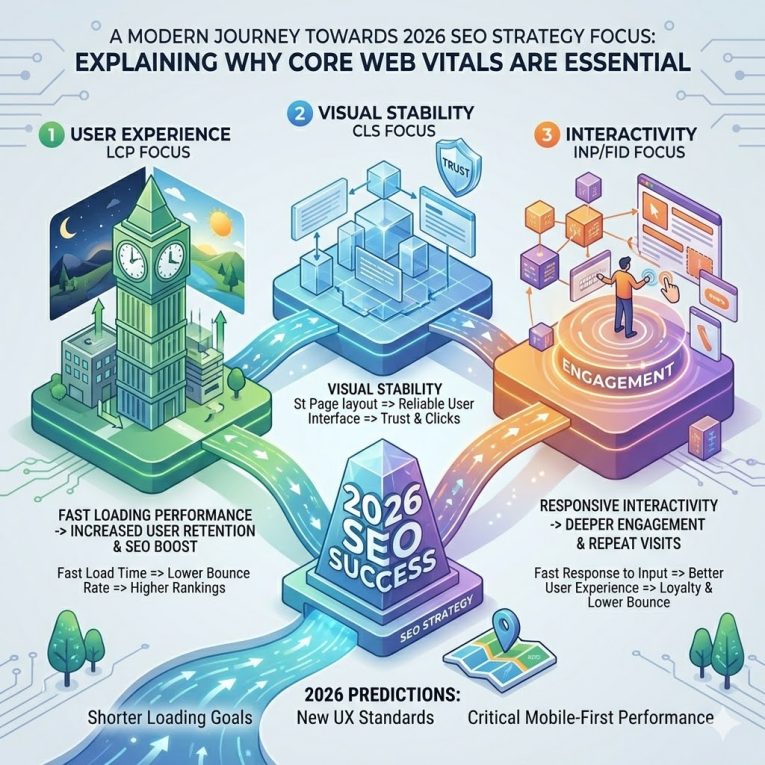
In today’s digital landscape, Core Web Vitals are no longer just a technical term; they have become a robust foundation for both your website’s Google rankings and its user experience. If your website is fast, smooth, and stable, both your rankings and your business stand to benefit directly.
Let’s understand this in simple terms:
1. Direct Impact on Google Rankings
This means that if your website’s speed and performance are strong, your chances of ranking at the top of search results increase significantly.
2. Enhanced User Experience
A fast and stable website keeps users satisfied and encourages them to stay engaged for longer periods.
3. Reduced Bounce Rate
However, on a fast and optimized site, visitors stay longer, which effectively lowers the bounce rate.
4. Increased Leads and Sales
When a website operates smoothly, conversions—specifically leads and sales—tend to rise.
5. Crucial for Mobile SEO
Since Google also prioritizes “mobile-first indexing,” optimizing Core Web Vitals for mobile devices is absolutely essential.
To improve Core Web Vitals, you need to work on both Technical SEO and Website Performance Optimization. Below are methods to improve each metric, explained:
LCP indicates your website’s loading speed; therefore, accelerating it is of utmost importance.
INP measures how quickly your website responds to user clicks or actions.
CLS ensures that content does not shift around while the website is loading.
If you want to understand and improve your website’s speed, performance, and Core Web Vitals scores, using the right tools is essential. These tools not only highlight issues but also provide actionable recommendations for fixing them.
Listed below are some of the most reliable tools:
1. Google PageSpeed Insights
This tool evaluates your website’s load performance and provides insights into its Core Web Vitals metrics.
Additionally, it offers suggestions for improvement for both mobile and desktop devices.
2. Google Search Console (Core Web Vitals Report)
This tool generates reports based on real-user data from your website.
It helps you identify which pages on your site are performing well and which ones require improvement.
3. Lighthouse (Chrome DevTools)
This is a developer tool that conducts a comprehensive audit of a website’s performance, SEO, and accessibility.
It can be accessed and used right inside the Chrome browser without any additional setup.
4. GTmetrix
GTmetrix provides a detailed analysis of your website’s speed and performance.
It displays metrics such as load time and page size, along with recommendations for optimization.
5. WebPageTest
This tool lets you check your website’s performance from multiple locations and on a range of devices.
This enables you to gain a better understanding of the actual user experience.
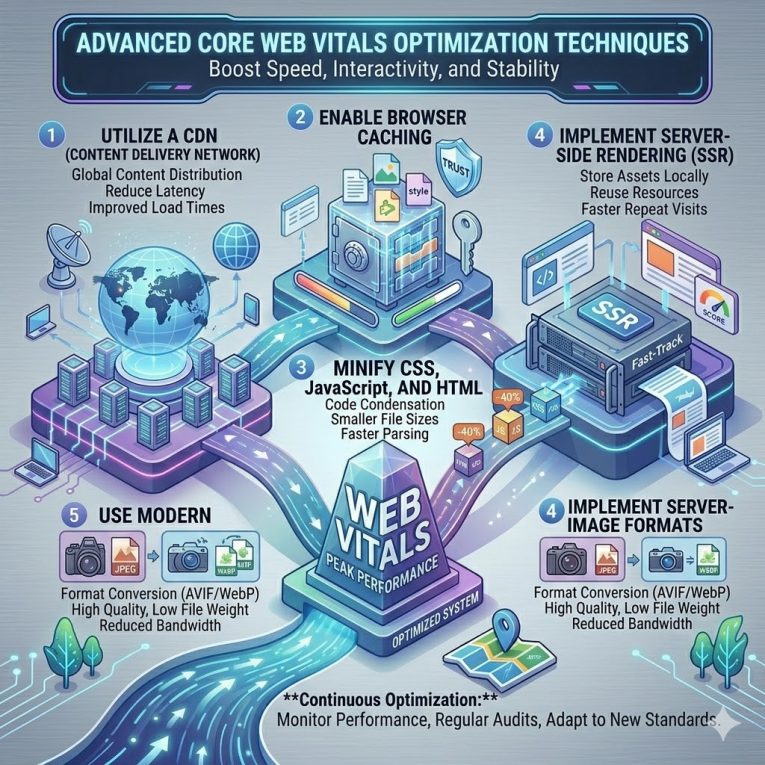
If you want to take your website’s performance to the next level, basic optimization alone is not enough. The advanced techniques listed below help further enhance your website’s speed, stability, and user experience:
1. Utilize a CDN (Content Delivery Network)
A CDN stores your website’s content across various servers located around the world.
This ensures users receive data from the server closest to them, thereby accelerating loading speeds—especially for international traffic.
2. Enable Browser Caching
Browser caching saves certain website data directly within the user’s browser.
When the same user revisits the website, the page loads significantly faster because the data is already stored locally.
3. Minify CSS, JavaScript, and HTML
Minification involves removing unnecessary spaces, comments, and redundant code.
This reduces file sizes and allows the website to load more quickly.
4. Implement Server-Side Rendering (SSR)
With SSR, the webpage’s content is generated directly on the server and becomes visible to the user much sooner.
This drastically improves the initial page load time and also offers benefits for SEO.
5. Use Modern Image Formats
Newer image formats, such as WebP and AVIF, deliver superior quality at smaller file sizes.
This reduces the website’s overall load and improves its LCP (Largest Contentful Paint) score.
In today’s digital landscape, the majority of users access websites via mobile devices; consequently, Google has prioritized Mobile-First Indexing. This implies that the mobile version of your website holds the utmost importance for SEO and search engine rankings.
If your site functions quickly, smoothly, and correctly on mobile devices, your Core Web Vitals score will improve, and the likelihood of achieving higher rankings on Google will significantly increase.
Adopt a Responsive Design
Your website should display correctly across all screen sizes—including mobile phones, tablets, and desktops.
Avoid Heavy Elements
Large images, videos, and unnecessary animations can slow down your website’s loading speed on mobile devices.
Optimize Mobile Images
Keep image file sizes to a minimum and utilize modern formats—such as WebP—to ensure faster page load times.
Minimize Pop-ups and Interstitials
Excessive pop-ups can annoy users and negatively impact your website’s overall performance.
Avoid these mistakes to improve your website’s speed and SEO:
Correcting these mistakes will result in a noticeable improvement in your website’s performance, Core Web Vitals score, and Google ranking.
The benefits of properly optimizing Core Web Vitals extend far beyond just SEO—they have a positive impact on your entire business. When your website is fast, smooth, and user-friendly, the results are directly reflected in your growth:
Faster Website = More Traffic
Fast-loading sites rank higher on Google, leading to an increase in organic visitors.
Better User Experience = Higher Conversions
A smooth and seamless website encourages users to take action—such as making a purchase or filling out a form.
Higher Rankings = Greater Visibility
When your site appears higher in search results, both your brand recognition and reach expand.
Lower Bounce Rate = Improved Engagement
Users spend more time on fast and stable websites, which boosts engagement.
In 2026, Core Web Vitals optimization is not merely a technical process; rather, it is a powerful strategy for enhancing your website’s speed, SEO rankings, and user experience.
When you focus on critical metrics such as LCP, INP, and CLS—and implement the right optimization techniques—your website becomes faster, more stable, and user-friendly—qualities that appeal to both users and Google alike.
If you wish to stay ahead in the online competitive landscape, start working on Core Web Vitals right now and transform your website into a high-performing, high-ranking, and conversion-focused platform.
Leave a Comment