Tejhaksh Technologies is the Website designing & Digital Marketing company based in Neemuch, established in 2020 providing Website design, Website development, Logo design, Domain Registration, Web hosting, Android App Development, eCommerce web development, Search Engine Optimization, Bulk SMS etc. We have good experience in developing different platform websites and we keep our eye on the latest technologies to implement on the website for better conversion and user experience.
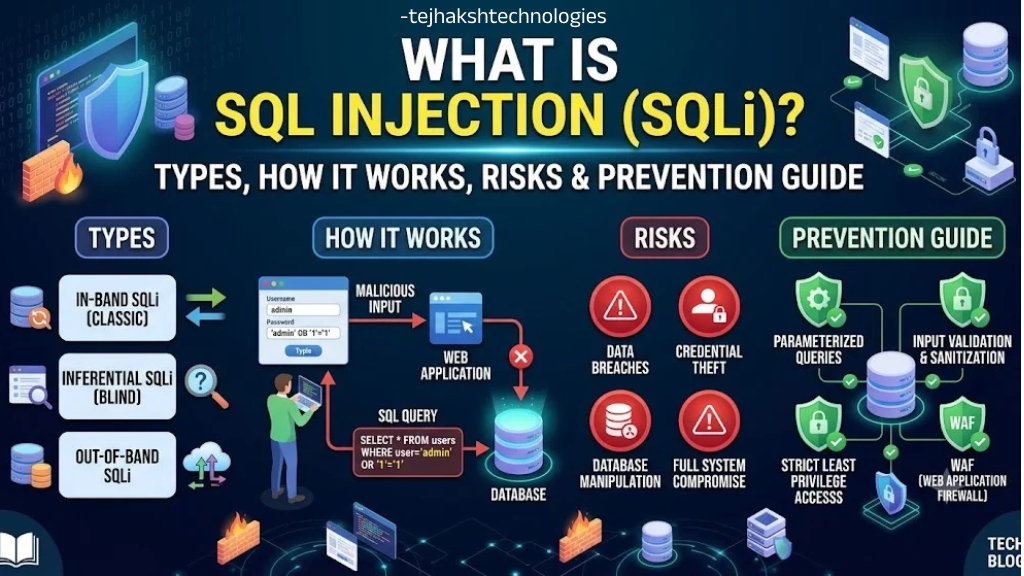
SQL Injection (SQLi) is a common web application security vulnerability that can allow attackers to access, modify, or misuse sensitive database information by exploiting unsafe user input.
Since websites rely on databases to store passwords, customer details, and business records, preventing SQL Injection is essential for protecting data and maintaining website security.
In this guide, you’ll learn what SQL Injection is, how it works, its different types, potential risks, and effective ways to detect and prevent SQLi attacks. Whether you’re a beginner or a developer, this guide will help you understand the basics of SQL Injection and build more secure web applications.
SQL Injection (SQLi) is a web security vulnerability that occurs when an application handles user input unsafely, allowing it to interfere with SQL queries. SQL stands for Structured Query Language, which is used to manage databases such as MySQL, PostgreSQL, and Microsoft SQL Server.
When developers construct database queries incorrectly, attackers may exploit this weakness to access sensitive information, modify records, or bypass certain security checks.
SQL Injection prevention involves using parameterized queries, validating user input, and applying appropriate database permissions to protect websites and their data.
SQL Injection Definition:
SQL Injection (SQLi) is a database security vulnerability that occurs when an application processes user input insecurely, allowing it to alter the intended logic of SQL queries and potentially expose or manipulate sensitive data.
SQL Injection is an important cybersecurity concern because many websites store sensitive information, such as usernames, passwords, customer details, and payment records in databases. If a website has an SQL Injection vulnerability, attackers may access private data, change records, or disrupt website operations.
The damage depends on the type of vulnerability, the data stored in the database, and the security measures used to protect it. Understanding SQL Injection helps developers build safer websites and protect important information from unauthorized access.
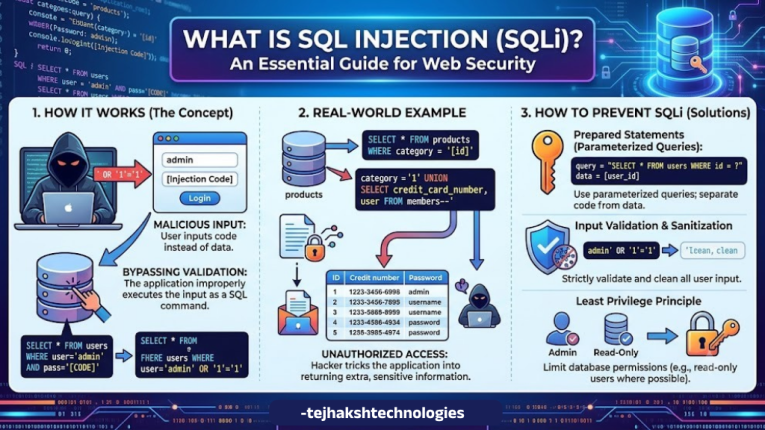
SQL Injection happens when a website handles user input incorrectly while communicating with its database. To understand it easily, let’s look at how the process works:
SQL Injection can happen when an application combines user input directly with SQL commands without proper protection. This may allow specially crafted input to change the query’s intended behavior, potentially exposing sensitive information or bypassing security checks.
Using parameterized queries helps keep user input separate from SQL commands and reduces the risk of SQL Injection.
Imagine a website that searches for a customer using their username. The database might use the following SQL query:
SELECT * FROM users WHERE username = ‘john’;
This command tells the database to find the user whose username is john.
The problem starts when a website adds user input directly to a SQL query without proper protection. Carefully crafted input could change the original query’s meaning, potentially allowing unauthorized access to information.
How can this problem be prevented?
Developers can use parameterized queries, which keep SQL commands separate from the values entered by users. This helps the database treat the supplied username as data instead of interpreting it as part of the SQL command.
In simple terms, SQL Injection occurs when unsafe query construction allows user input to interfere with database instructions. Using parameterized queries is one of the most effective ways to prevent this vulnerability.
SQL Injection vulnerabilities often occur when developers do not follow secure database practices. Some common causes include:
Avoiding these mistakes and following secure coding practices can significantly reduce SQL Injection risks and help protect website databases.
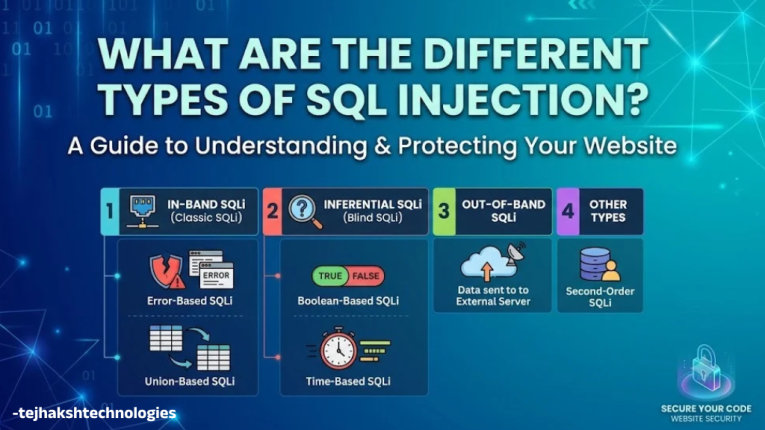
SQL Injection attacks can be classified according to how an application processes injected input and how an attacker might observe the result.
The main categories include in-band SQL Injection, inferential or blind SQL Injection, and out-of-band SQL Injection.
In-Band SQL Injection occurs when an attacker sends input to a vulnerable website and receives information through the same channel, usually the website’s response.
Error-Based SQL Injection
Error-Based SQL Injection occurs when database errors reveal details about how a query is processed. These messages may expose information about the database system, query structure, or application configuration.
Although error messages help developers find problems, displaying detailed database errors to website visitors can create security risks. Websites should show general error messages to users and keep technical details in secure server logs.
UNION-Based SQL Injection
UNION-Based SQL Injection takes advantage of the SQL UNION operator, which combines results from two or more compatible queries. If a website builds SQL queries insecurely, this weakness may allow unauthorized information to appear in the application’s response.
The possible impact depends on how the query is written, the data accessible to the application, and the database user’s permissions.
Blind SQL Injection is a type of SQL Injection in which a website does not directly show database results or detailed error messages. Instead, an attacker may try to understand database information by observing how the website responds to different inputs.
This vulnerability can be difficult to detect because the website may appear to work normally, even when its database queries are not secure.
Blind SQL Injection has two main types:
Using parameterized queries, reviewing application behavior, and conducting regular security testing can help identify and prevent Blind SQL Injection vulnerabilities.
Boolean-Based Blind SQL Injection is a technique in which an attacker tries to gather information by observing how a website responds to conditions that are either true or false.
For example, a vulnerable website may show different results depending on whether a database condition is correct. By comparing these responses, an attacker may gradually learn information about the database, even when the website does not display database details directly.
How to prevent it: Developers should use parameterized queries, restrict database permissions, and regularly test their applications to identify unusual response patterns and potential SQL Injection vulnerabilities.
Time-Based Blind SQL Injection is a technique in which an attacker studies how long a website takes to respond to certain requests. Differences in response time may reveal information about the database, even when no results or error messages are displayed.
Prevention: Use parameterized queries, monitor unusual response delays, and regularly check application logs for suspicious activity.
Out-of-Band SQL Injection occurs when an attacker attempts to obtain database information through a separate communication channel instead of the website’s normal response. This technique may work only when the database and network settings support such communication.
Prevention: Restrict unnecessary outgoing network connections, limit database permissions, and use parameterized queries to protect applications against SQL Injection.
SQL Injection (SQLi) is a security vulnerability that can allow user input to interfere with database queries. Blind SQL Injection is a specific type of SQLi in which the website does not directly display database results or useful error messages.
Both vulnerabilities can occur when an application handles user input unsafely.
Prevention: Use parameterized queries, apply appropriate database permissions, and regularly test applications for security weaknesses.
A compound SQL Injection attack generally refers to a situation where SQL Injection is combined with other security weaknesses to cause greater damage. The term does not have one universally accepted technical definition.
For example, an attacker might exploit an SQL Injection vulnerability along with weak access controls to access information they should not be allowed to see.
Unlike common SQL Injection types, such as in-band, blind, and out-of-band SQLi, a compound attack may involve multiple vulnerabilities working together.
How to prevent it: Use parameterized queries, restrict database permissions, enforce proper access controls, and monitor suspicious activity. Fixing each security weakness helps reduce the risk of combined attacks.
SQL Injection attacks can create serious problems for websites, businesses, and their users. The level of damage depends on the weakness being exploited, the data stored in the database, and the security measures protecting it.
Here are the major risks of SQL Injection:
1. Unauthorized Access to Sensitive Information
Attackers may gain access to private database records, such as customer details, email addresses, account information, or confidential business data. This can put user privacy at risk.
2. Login and Access Control Problems
An SQL Injection vulnerability may interfere with a website’s login process or security checks. In some cases, this could allow unauthorized users to access accounts or restricted features.
3. Data Modification or Deletion
Attackers may be able to change or delete database records if the vulnerable application has sufficient permissions. This can damage customer accounts, order details, financial records, and other important information.
4. Financial Loss
A security breach can lead to expenses for investigating the incident, restoring systems, recovering data, and improving security. Businesses may also face legal costs or regulatory penalties, depending on the circumstances.
5. Damage to Business Reputation
Customers expect websites to protect their personal information. If a company suffers a data breach, customers may lose trust in its services, affecting its reputation and future business.
6. Website Downtime and Disruption
Some SQL Injection attacks may damage database records or interfere with application performance. This can make a website slow, unavailable, or unable to perform important business operations.
7. Legal and Privacy Issues
If an attack exposes personal or confidential information, the organization may need to meet legal, contractual, or regulatory requirements. The consequences depend on the type of data involved and the laws that apply.
SQL Injection can be prevented by writing secure database queries and protecting user input properly. Developers should follow security practices that keep database information safe and reduce the chances of unauthorized access.
Here are some effective ways to protect websites and applications from SQL Injection.
Parameterized queries are one of the best ways to prevent SQL Injection. They keep SQL commands separate from the information entered by users, so the database treats user input as data rather than a command.
Example using Python:
cursor.execute(
“SELECT * FROM users WHERE username = %s”,
(username,)
)
This example uses a parameterized query to safely handle the username.
Best Practice: Avoid adding user input directly to SQL query strings.
Object-Relational Mapping (ORM) frameworks help developers work with databases using programming language features instead of writing every SQL query manually.
Many ORM tools provide automatic protection through parameterized queries when used correctly. However, unsafe raw SQL or dynamically created queries can still cause SQL Injection.
Best Practice: Use the ORM’s secure query methods and avoid placing untrusted input directly into SQL statements.
Input validation checks whether the information entered by users matches the expected format.
For example:
Validation helps prevent incorrect or unexpected input from entering application processes.
Best Practice: Use input validation along with parameterized queries instead of relying on validation alone.
Some database elements, such as table names, column names, and sorting options, cannot generally be handled using ordinary SQL parameters.
When these elements need to change dynamically, developers should allow only predefined and trusted options.
For example, a website may provide a sorting menu with options such as price, name, or date.
Best Practice: Map user selections to approved SQL elements instead of inserting arbitrary input into the query.
Database accounts should have only the permissions required to perform their assigned tasks.
For example, an application that displays customer information may only need permission to read certain records. It should not automatically have permission to delete records or change database settings.
This approach follows the Principle of Least Privilege.
Best Practice: Give application database accounts limited permissions to reduce the possible damage from a security breach.
Database error messages can reveal information about the application’s internal structure, database configuration, or query processing.
Displaying these details publicly may create additional security risks.
Instead, websites should show simple error messages to users and keep technical information in protected server-side logs.
Best Practice: Never expose database credentials, detailed SQL errors, or sensitive technical information in public error messages.
Older software may contain security weaknesses that attackers can exploit.
Developers should regularly update:
Best Practice: Apply security updates regularly and replace unsupported software with maintained alternatives.
A Web Application Firewall helps protect websites by examining incoming requests and identifying suspicious activity.
It may block requests that match known SQL Injection attack patterns before they reach the application.
However, a WAF cannot detect or prevent every SQL Injection vulnerability.
Best Practice: Use a WAF as an additional security layer while fixing vulnerable database queries in the application code.
Security testing helps developers discover SQL Injection vulnerabilities before attackers exploit them.
Common testing methods include:
Best Practice: Regularly test login pages, search forms, filters, and other features that interact with databases.
Monitoring helps identify unusual activity that may indicate a security problem.
Developers and security teams should look for:
Application logs should be protected and should not unnecessarily store passwords, access tokens, or sensitive personal information.
Best Practice: Review security logs regularly and investigate suspicious activity promptly.
SQL Injection vulnerabilities can be detected by checking application code, monitoring database errors, and testing website security.
Note: Always test applications with proper permission and fix any confirmed vulnerabilities promptly.
Developers can protect applications from SQL Injection by following these security practices:
Following these practices helps developers build safer applications and reduce the risk of SQL Injection attacks.
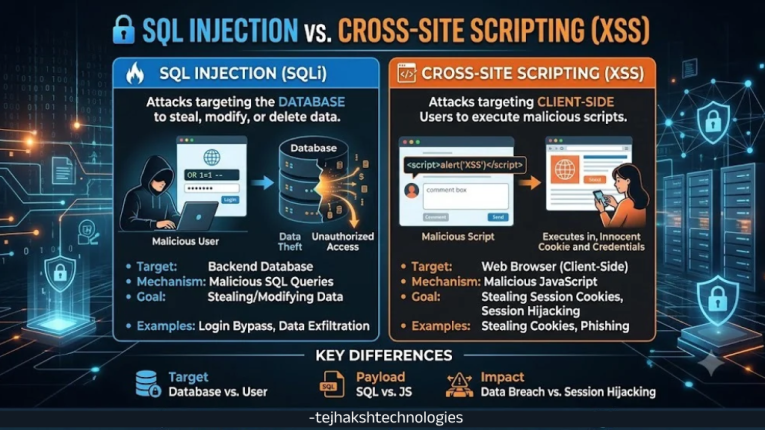
SQL Injection (SQLi) and Cross-Site Scripting (XSS) are common web application security vulnerabilities, but they differ in their causes, targets, impacts, and prevention methods.
1. Primary Target
2. Main Cause
3. Potential Impact
4. Main Prevention Method
5. Additional Security Measures
6. Key Difference
SQL Injection (SQLi) is a serious security risk that can expose sensitive data and damage databases. Developers can reduce this risk by using parameterized queries, validating user input, limiting database permissions, and keeping software updated.
Regular security testing, safe coding practices, and database monitoring help protect web applications from attacks.
Whether you are a beginner or an experienced developer, learning SQL Injection prevention is essential for building secure and reliable applications.
Leave a Comment