

- October 23, 2026
- Tejhaksh
- 0 Comments
- Software Composition Analysis, Uncategorized
What Is Software Composition Analysis? A Complete Guide to SCA
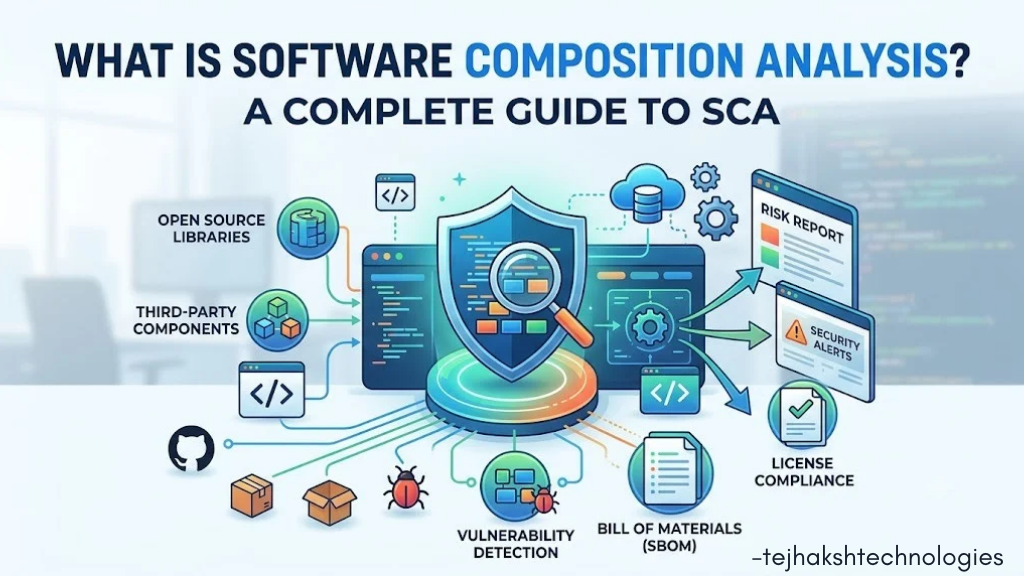
Today’s software applications are built using a combination of developer-written code, third-party libraries, and open-source components. Many applications use open-source libraries, third-party packages, frameworks, and external components to save time and improve functionality. While these components make development faster, they can also introduce security vulnerabilities, outdated dependencies, and software license issues.
This is where Software Composition Analysis (SCA) becomes important. SCA helps organizations identify the components used in their applications, detect known security risks, check open-source licenses, and manage software dependencies more effectively.
In this guide, you will learn what Software Composition Analysis is, how SCA works, its key benefits and features, popular SCA tools, common challenges, and the differences between SCA, SAST, and DAST.
What Is Software Composition Analysis (SCA)?
Software Composition Analysis (SCA) is a security process that identifies and analyzes open-source and third-party components used in a software application. It helps development and security teams discover vulnerable libraries, outdated packages, license compliance issues, and other risks associated with software dependencies.
Most modern applications use external components instead of building every feature from scratch. For example, a web application may use a JavaScript library for its interface, a package for processing data, and a third-party framework for authentication.
Although these components make development easier, they may contain security weaknesses that attackers can exploit. Developers may also be unaware of all the indirect dependencies included in their projects.
SCA tools automate the process of discovering these components and checking them against vulnerability databases, license information, and other risk sources. They help teams understand what their software contains and which components need attention. <Cite refs={[“turn505053search0″,”turn505053search1”]}/>
Why Is Software Composition Analysis Important?
Open-source software is widely used because it is flexible, cost-effective, and supported by developer communities. However, using an external library also means relying on code that your organization may not directly maintain.
A vulnerable dependency can put an entire application at risk, even when the application’s own code is well written. Similarly, using a library with unsuitable license terms may create legal or compliance concerns.
Software Composition Analysis helps address these risks by providing visibility into software components and making dependency management more systematic.
For example, suppose a company uses an outdated logging library in its application. An SCA scan may identify the library version, flag a known vulnerability, and recommend updating to a safer version. The development team can then investigate the finding and apply the appropriate fix.
SCA is particularly useful for organizations that develop web applications, mobile apps, enterprise software, APIs, cloud-native services, and products that rely heavily on open-source packages.
How Does Software Composition Analysis Work?
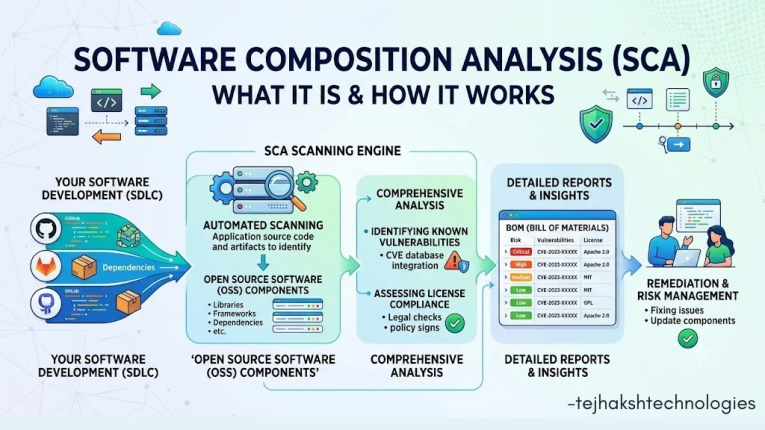
Software Composition Analysis works by examining an application’s components, identifying its dependencies, checking for known risks, and reporting findings to development and security teams.
Although the exact process varies between tools, most SCA solutions follow these main steps.
1. Scan the Application
The first step is to scan the application’s source code, dependency files, build artifacts, or other supported software packages.
SCA tools may inspect files such as package.json, package-lock.json, pom.xml, and other package manager files, depending on the programming language and technology used.
These files help the tool identify which libraries and package versions are included in the project.
2. Identify Direct and Transitive Dependencies
An application may use dependencies in two ways:
- Direct dependencies: Libraries that developers add directly to a project.
- Transitive dependencies: Additional libraries required by the direct dependencies.
For example, your application may use Library A, which relies on Library B. Even if your team never installs Library B directly, it may still become part of the application.
SCA tools help identify both types of dependencies, making it easier to discover hidden risks.
3. Create a Software Bill of Materials (SBOM)
Many SCA solutions can generate a Software Bill of Materials, commonly known as an SBOM. An SBOM is an inventory of software components included in an application.
Depending on the tool and format, it may include component names, versions, suppliers, licenses, and dependency relationships.
An SBOM gives organizations a clearer view of their software supply chain. It can also help them determine which applications may be affected when a vulnerability is discovered in a particular library.
4. Check for Known Security Vulnerabilities
After identifying dependencies, the SCA tool compares component information with vulnerability databases and other security intelligence sources.
The tool may flag components associated with known vulnerabilities, including published Common Vulnerabilities and Exposures (CVE) records.
Findings often include information such as the affected package version, vulnerability severity, and recommended remediation. Some tools also assess exploitability or whether vulnerable code paths are reachable in the application.
5. Analyze License and Compliance Risks
Open-source software can be distributed under different licenses, each with its own conditions.
SCA tools can identify the licenses associated with dependencies and flag licenses that may conflict with an organization’s policies. This allows teams to review potential obligations before distributing or deploying software.
Automated license detection supports compliance reviews, but legal teams may still need to assess complex licensing questions.
6. Generate Reports and Fix Issues
Once the scan is complete, the SCA tool displays findings through reports, dashboards, alerts, or development workflow integrations.
Teams can use these results to prioritize vulnerable components, update outdated packages, replace risky libraries, or investigate license concerns.
Some tools can recommend safer versions or create automated update requests. Developers should test recommended changes before merging them into production code.
7. Monitor Dependencies Continuously
Software security is an ongoing process. A component that has no known vulnerability today may be affected by a newly disclosed issue tomorrow.
Continuous SCA monitoring helps organizations identify new risks as vulnerability information changes. Integrating SCA into development pipelines and ongoing monitoring processes makes it easier to respond quickly.
Benefits of Software Composition Analysis
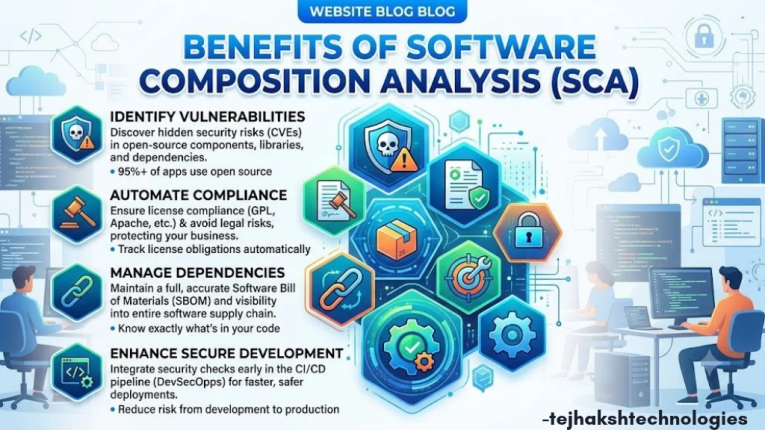
Software Composition Analysis helps businesses manage third-party dependencies, identify security risks, and use open-source software more safely.
1. Early Detection of Security Vulnerabilities
A key advantage of SCA is that it helps detect known security weaknesses in third-party libraries and software components.
Instead of waiting for a security incident, teams can discover affected packages during development and address them before release, where possible.
Early detection can reduce remediation costs and lower the likelihood of deploying vulnerable components.
2. Better Open-Source Security
Open-source libraries can introduce risks that are difficult to identify through manual reviews alone.
SCA tools help organizations maintain an inventory of dependencies and understand which components require security attention. This improves visibility and supports more informed decisions about using external packages.
3. Improved License Compliance
Different open-source licenses have different requirements. Some may require attribution, preservation of license notices, or compliance with additional distribution conditions.
SCA helps identify the licenses associated with software components and flag potential policy conflicts. This supports compliance reviews and helps teams make informed decisions about component usage.
4. Greater Software Supply Chain Visibility
Organizations often use hundreds or thousands of software components across their applications. Without an accurate inventory, it can be difficult to know where a vulnerable library is being used.
SCA provides visibility into direct and indirect dependencies. When a new vulnerability is disclosed, teams can more quickly identify potentially affected applications and components.
5. Faster and More Efficient Development
Reviewing each software dependency manually for security flaws, version updates, and license requirements can be time-consuming. SCA tools automate these checks, helping developers save time and focus on software development while receiving security alerts directly through their existing tools.
6. Better Risk Prioritization
Not every vulnerability presents the same level of risk to every application.
Some SCA tools provide severity scores, exploitability information, reachability analysis, or runtime context to help teams decide which issues need attention first.
This helps organizations focus on the most important findings rather than treating every alert as equally urgent.
7. Support for DevSecOps Practices
DevSecOps brings security into the software development and delivery process instead of treating it as a final checkpoint.
Integrating SCA into development environments, code repositories, and CI/CD pipelines helps teams identify dependency risks earlier and establish consistent security checks before software is released.
8. Ongoing Dependency Management
SCA can help teams find outdated, unsupported, or vulnerable dependencies that may need updating or replacement.
Regular monitoring makes dependency maintenance more predictable and helps organizations reduce their reliance on components that are no longer suitable for their security requirements.
Key Features of Software Composition Analysis
SCA tools offer different capabilities depending on the product and subscription. When evaluating a solution, consider the following features.
1. Dependency Discovery
Dependency discovery identifies open-source and third-party packages used in an application. A capable tool should detect direct dependencies and, where supported, transitive dependencies across the technologies your organization uses.
2. Vulnerability Detection
Vulnerability detection compares identified components with security databases and other intelligence sources. It helps teams locate known issues associated with specific package versions.
3. Software Bill of Materials (SBOM) Generation
SBOM generation creates a structured inventory of software components. This inventory can support vulnerability response, audits, compliance reviews, and software supply chain management.
4. License Compliance Management
License management identifies the licenses associated with dependencies and highlights components that may violate organizational policies.
This feature is useful for businesses that distribute commercial software or need to meet specific licensing requirements.
5. Automated Alerts and Reporting
Automated alerts notify teams about newly identified vulnerabilities or other dependency risks. Reports provide details about affected components, severity, and possible remediation steps.
6. CI/CD Pipeline Integration
Integration with continuous integration and continuous delivery pipelines allows SCA scans to run automatically during development and build processes.
Organizations can configure policies to warn developers or block a build when certain security or compliance requirements are not met.
7. Risk-Based Prioritization
Advanced SCA tools may consider vulnerability severity, exploitability, reachable code, and runtime usage to help teams prioritize findings.
These capabilities can reduce unnecessary alerts and make remediation decisions more practical.
8. Automated Remediation Support
Some tools suggest safer package versions, recommend alternative components, or create pull requests for dependency updates.
Automation can speed up maintenance, but developers should review and test changes to avoid compatibility issues or unexpected application behavior.
9. Continuous Monitoring
Continuous monitoring helps teams track dependencies after the initial scan. This is important because new vulnerabilities can be reported after an application has already been released.
10. Support for Multiple Languages and Package Managers
Businesses may develop applications using several programming languages and frameworks. An SCA solution should support the relevant ecosystems, package managers, repositories, and deployment environments used by the organization.
Software Composition Analysis Tools
Software Composition Analysis tools help organizations discover software dependencies, detect known vulnerabilities, review open-source licenses, and manage supply chain risks. The right tool depends on your programming languages, development environment, security requirements, and budget.
Here are some popular SCA tools to consider.
1. Snyk Open Source
Snyk Open Source helps developers identify vulnerabilities in open-source dependencies and offers guidance on fixing affected packages. It can integrate with supported repositories and development workflows to provide security feedback during coding and builds.
It is useful for development teams looking for dependency security checks alongside developer-focused remediation guidance.
2. Mend
Mend provides software composition analysis capabilities for identifying vulnerable open-source components and managing license compliance. Its features can help organizations understand dependency risks and establish policies for open-source usage.
It may be suitable for businesses that need dependency security and license governance across multiple projects.
3. OWASP Dependency-Check
OWASP Dependency-Check is an open-source tool that attempts to identify publicly disclosed vulnerabilities in project dependencies. It supports several technology ecosystems and can be incorporated into supported build processes.
It is worth considering for teams that want an open-source option for dependency vulnerability analysis. Its detection coverage and configuration requirements should be evaluated for your particular projects.
4. GitHub Dependabot
GitHub Dependabot helps developers identify vulnerable dependencies and keep supported packages updated. It can generate alerts for known dependency vulnerabilities and create pull requests to update dependencies when suitable fixes are available.
It is especially convenient for teams that manage their source code and development workflow on GitHub.
5. GitLab Dependency Scanning
GitLab offers dependency scanning capabilities that help identify known vulnerabilities in application dependencies. Depending on the configuration and GitLab offering, findings can be integrated into development workflows and reports.
It can be a practical choice for teams already using GitLab for source control and CI/CD.
6. OWASP Dependency-Track
OWASP Dependency-Track is an open-source platform designed to help organizations monitor software components and manage software supply chain risk. It uses Software Bill of Materials data to track components and assess vulnerability information over time.
It is particularly useful for organizations that want to manage component risk across multiple applications and versions.
These tools offer different capabilities, so compare their supported ecosystems, vulnerability data, license analysis, SBOM formats, integration options, and remediation features before making a decision.
Challenges of Software Composition Analysis
Although SCA improves dependency security, it also comes with challenges. Understanding these limitations helps organizations implement a more effective strategy.
1. False Positives
SCA tools may flag a component even when the reported vulnerability does not affect the application’s actual usage. For example, a vulnerable function may exist in a library but never be called by the application.
False positives can consume developer time and make it harder to identify the most urgent issues.
How to address it: Review findings in context and use reachability analysis or runtime information when available. Do not ignore an alert without validating the risk.
2. Large Numbers of Dependencies
Modern applications often rely on many direct and indirect dependencies. Tracking every package, version, and relationship can become difficult as projects grow.
How to address it: Automate dependency discovery, maintain accurate component inventories, and regularly review outdated or unnecessary packages.
3. Frequently Changing Vulnerability Information
New vulnerabilities can be disclosed after software has been scanned or deployed. A clean scan therefore does not guarantee that an application will remain free from known dependency vulnerabilities.
How to address it: Enable ongoing monitoring and rescan projects when relevant vulnerability information changes.
4. License Complexity
Open-source licenses have different conditions, and automated tools may not fully resolve every legal or compliance question. Some components may also contain incomplete or inaccurate license metadata.
How to address it: Establish an open-source usage policy and involve qualified legal or compliance specialists when a license requires further review.
5. Difficulty Prioritizing Findings
A report may contain many vulnerabilities, but not every issue presents the same level of risk. Teams can struggle to decide which findings to fix first.
How to address it: Consider severity, exploitability, exposure, application importance, and whether the vulnerable component is actually used. Prioritize issues based on real-world risk rather than severity scores alone.
6. Compatibility Issues During Updates
Updating a vulnerable dependency can sometimes break existing functionality, introduce incompatible changes, or require updates to other packages.
How to address it: Test dependency updates in a controlled environment, run automated tests, and review release notes before deploying changes.
7. Integration and Performance Challenges
Adding SCA to large projects or complex CI/CD pipelines may increase build times and require additional configuration. Different tools may also provide different results or formats.
How to address it: Start with important projects, select tools that integrate with existing workflows, and adjust scan frequency and pipeline policies to balance security with development speed.
SCA vs. SAST and DAST
Software Composition Analysis, Static Application Security Testing, and Dynamic Application Security Testing are different application security methods. Each focuses on a different type of risk.
Using them together can provide broader security coverage than relying on a single testing approach.
What Is SAST?
Static Application Security Testing (SAST) analyzes source code or other supported code representations without running the application. It looks for potential security weaknesses in code written by developers.
Examples include unsafe input handling, insecure coding patterns, and certain injection risks.
SAST helps developers discover code-level issues during development, before an application reaches production.
What Is DAST?
Dynamic Application Security Testing (DAST) tests a running application from the outside. It sends requests and examines responses to identify potential security weaknesses in the application’s behavior.
DAST can help uncover issues such as certain authentication weaknesses, insecure configurations, and vulnerabilities that become visible when the application runs.
Because DAST tests a running application, its findings depend on the application being accessible and the tests covering the relevant functionality.
Difference Between SCA, SAST, and DAST
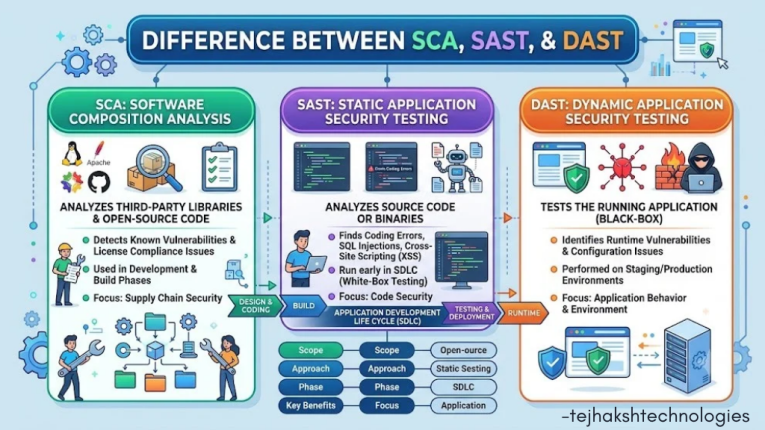
– SCA (Software Composition Analysis): Checks open-source and third-party dependencies for vulnerabilities, outdated packages, and license issues.
– SAST (Static Application Security Testing): Analyzes source code to identify potential security flaws without running the application.
– DAST (Dynamic Application Security Testing): Tests a running application to find security weaknesses and configuration issues.
Key Differences
– Main focus: SCA checks dependencies, SAST checks source code, and DAST checks running applications.
– How they work: SCA scans components, SAST analyzes code, and DAST tests application behavior.
– Common findings: SCA finds vulnerable packages, SAST detects insecure coding patterns, and DAST identifies runtime weaknesses.
– Running application required: SCA — usually no; SAST — no; DAST — yes.
– License checking: SCA supports license compliance; SAST and DAST do not primarily focus on it.
– When to use: SCA during development and monitoring, SAST during coding and code review, and DAST during application testing.
Which Security Testing Method Should You Choose?
The best choice depends on the risk you want to address.
- Choose SCA to discover vulnerable dependencies, review open-source licenses, and understand your software components.
- Choose SAST to find potential security flaws in your own source code.
- Choose DAST to test a running application for weaknesses that appear during execution.
For most organizations, these methods are complementary rather than competing options. SCA checks the components an application uses, SAST examines code-level risks, and DAST evaluates the behavior of a running application.
Best Practices for Implementing Software Composition Analysis
To get the most value from SCA, organizations should make dependency security part of their regular development process.
Scan Dependencies Early
Integrate SCA scans into the development and code review stages rather than leaving them until the final release. Detecting dependency risks early gives developers enough time to fix issues before deployment.
Include Transitive Dependencies
Do not focus only on packages added directly by developers. Indirect dependencies can also introduce vulnerabilities, so choose tools that provide visibility into the dependency relationships relevant to your projects.
Set Clear Security Policies
Define which vulnerabilities require immediate action, which licenses are permitted, and when a build should fail a security check. Clear policies help teams respond consistently.
Prioritize High-Risk Issues
Use vulnerability severity alongside exploitability, application exposure, and business impact. This helps developers focus on issues that matter most.
Keep Dependencies Updated
Regularly review package versions and remove dependencies that are no longer required. Apply security patches promptly, while testing updates to protect application stability.
Integrate SCA Into CI/CD
Automate dependency scans in supported build and delivery pipelines. This helps teams detect new risks as code changes and reduces reliance on manual checks.
Monitor Released Applications
Continue monitoring component inventories after deployment. Newly disclosed vulnerabilities may affect applications that previously passed their security checks.
Review and Improve Regularly
Measure remediation times, recurring vulnerabilities, false positives, and policy exceptions. Use these results to improve security processes and tool configurations.
FAQ's About Software Composition Analysis
1. Why is SCA important for application security?
SCA helps organizations find risks in external software components that may not be visible by reviewing their own source code alone. It improves dependency visibility and supports earlier vulnerability detection and remediation.
2. What does an SCA tool detect?
Depending on its capabilities, an SCA tool can identify known vulnerabilities, direct and transitive dependencies, outdated packages, license risks, and other component-related issues. Some tools also generate SBOMs and support continuous monitoring.
3. What is an SBOM in Software Composition Analysis?
A Software Bill of Materials (SBOM) provides a detailed list of the libraries, packages, and other components used in an application. It improves software supply chain visibility and helps teams quickly find affected components when new security vulnerabilities emerge.
4. What is the difference between SCA and SAST?
SCA focuses on third-party and open-source dependencies, including known vulnerabilities and license risks. SAST analyzes custom source code to identify potential security flaws. Both methods address different risks and can be used together.
5. What is the difference between SCA and DAST?
SCA analyzes software components and their associated risks, usually without running the application. DAST tests a running application to identify potential weaknesses in its behavior and responses.
6. Are there free Software Composition Analysis tools?
Yes, several free SCA solutions are available, including OWASP Dependency-Check and Dependency-Track. GitHub and GitLab also provide dependency security features, though available options may vary by plan. Check each tool’s documentation to ensure it meets your project’s requirements.
7. How often should SCA scans be performed?
Run SCA scans whenever dependencies are updated, new builds are created, or security vulnerabilities are reported. Continuous monitoring also helps teams detect newly emerging threats without waiting for the next scheduled scan.
8. Can SCA eliminate all software vulnerabilities?
No. SCA primarily helps identify risks associated with software components and known vulnerabilities. It does not replace secure coding, SAST, DAST, penetration testing, or other security controls.
Conclusion
Software Composition Analysis is an important part of modern application security because it helps organizations understand and manage risks introduced by open-source and third-party dependencies. By identifying components, detecting known vulnerabilities, reviewing licenses, and monitoring changes, SCA supports safer and more informed software development.
Choosing the right SCA tool, integrating it into development workflows, and reviewing findings regularly can improve software supply chain visibility and reduce dependency-related risks.
For stronger application security, use SCA alongside SAST, DAST, secure coding practices, and continuous monitoring. A layered approach helps teams build, test, and maintain software with greater confidence.
Leave a Comment