

- November 3, 2026
- Tejhaksh
- 0 Comments
- Microsoft, Uncategorized
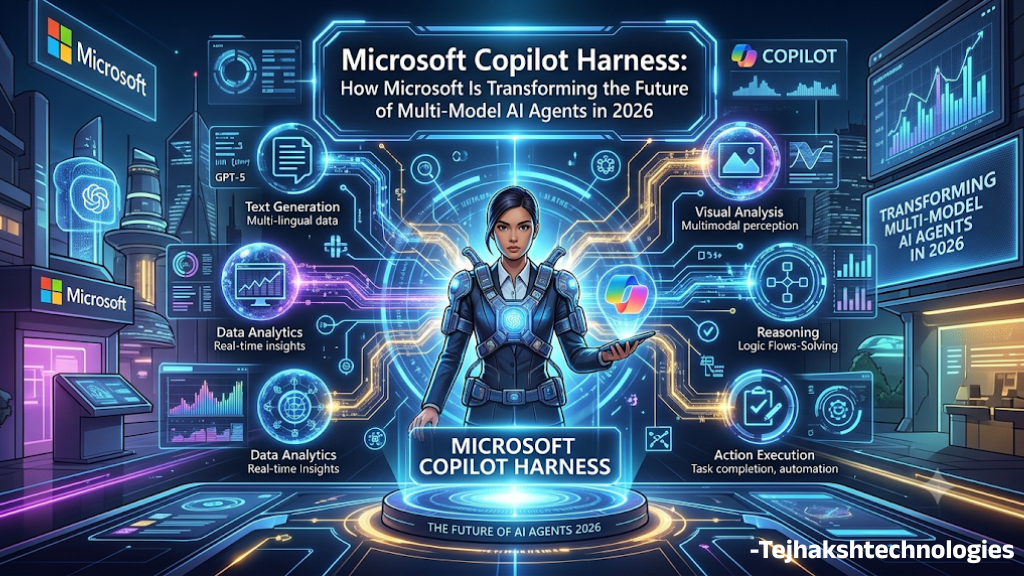
Microsoft Copilot Harness: How Microsoft Is Transforming the Future of Multi-Model AI Agents in 2026
Today, Artificial Intelligence is doing much more than just answering questions. Modern AI systems can understand instructions, use different software tools, manage information, and complete tasks that involve multiple steps. These advanced systems are known as AI Agents.
Understanding this growing use of AI, Microsoft has introduced a new technology called Microsoft Copilot Harness. It is designed to make AI agents smarter, more flexible, and better at handling complex tasks.
Announced on October 28, 2026, Microsoft Copilot Harness is an important development in Microsoft’s AI technology. Instead of depending on just one AI model, it allows multiple AI models to work together using a common system.
This technology can be helpful for developers, startups, software companies, and large businesses that want to build powerful AI applications without creating all the required infrastructure themselves.
But what exactly is Microsoft Copilot Harness? How does it work? How is it different from a normal AI chatbot? And how can it help businesses in the future?
Let’s understand everything step by step in simple language.
What Is Microsoft Copilot Harness?
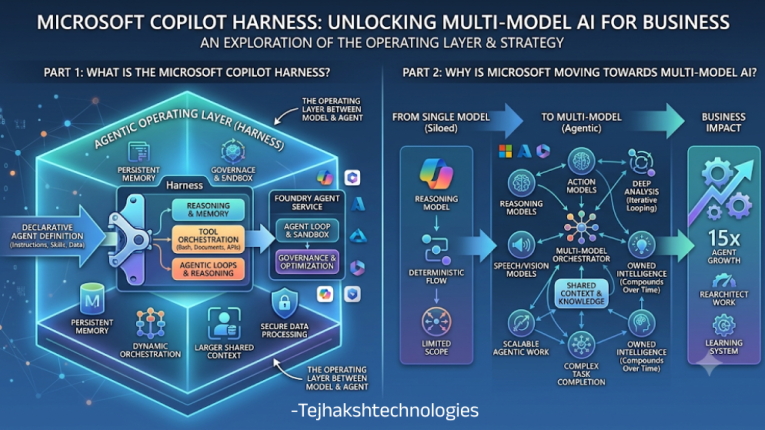
Microsoft Copilot Harness is an AI orchestration technology that provides the infrastructure required for AI models to perform meaningful tasks.
To understand it, imagine that an AI model is the brain of a digital worker. The brain can understand information, generate ideas, and make decisions. However, completing a real-world assignment requires much more than intelligence.
A digital worker also needs:
- Clear instructions about what to accomplish.
- Access to relevant information and working context.
- Tools to interact with different applications.
- An environment in which tasks can be executed.
- Controls to manage permissions and operations.
- A system to coordinate multiple steps until the task is completed.
This is where an AI harness becomes important.
The Microsoft Copilot Harness acts as the supporting infrastructure that connects these capabilities. It coordinates how an AI agent receives instructions, accesses tools, manages context, and executes tasks.
In simple terms, an AI model provides the intelligence, while the harness provides the environment and operational structure that allow that intelligence to accomplish useful work.
Microsoft is making this technology available through Microsoft Foundry, giving developers and enterprise customers a managed foundation for building more capable AI agents.
Why Is Microsoft Moving Towards Multi-Model AI?
One of the biggest changes happening in the artificial intelligence industry is the growing number of AI models.
Different models have different strengths. Some are particularly effective at programming, while others are useful for reasoning, research, writing, data processing, and understanding complex instructions.
This creates an important challenge for developers.
If a company builds its entire AI application around one model, it may miss opportunities to use better alternatives when technology improves.
For example, consider a business application that performs three different operations:
- Analysing large amounts of business data.
- Generating software code.
- Understanding customer questions and preparing responses.
A single AI model may not always provide the best performance across all three activities.
A multi-model AI architecture allows developers to choose models according to the requirements of individual tasks.
This is the direction Microsoft is pursuing with its Copilot Harness.
According to Microsoft’s announcement, the harness supports more than 20 frontier models and also offers a bring-your-own-key approach. This gives developers greater flexibility when selecting the intelligence behind their AI agents.
The biggest advantage is that changing the underlying AI model does not necessarily require rebuilding the entire application infrastructure.
This could make AI development more adaptable as new models enter the market.
How Does Microsoft Copilot Harness Work?
The easiest way to understand the technology is to imagine an AI agent working as a virtual employee.
Suppose a business owner asks an AI agent to prepare a weekly performance report.
The task may involve collecting information, analysing numbers, creating summaries, and preparing a final document.
A traditional chatbot might generate instructions explaining how to complete the report. A more advanced AI agent can interact with connected tools and work through the different stages.
The harness helps coordinate this process.
Step 1: Understanding the task
The AI agent receives the user’s instructions and identifies what needs to be completed.
Step 2: Managing context
The system provides relevant information and instructions so the agent can understand the task and maintain useful working context.
Step 3: Selecting the appropriate model
Depending on the task, the orchestration system can use an appropriate supported AI model or models.
Step 4: Connecting with tools
The agent can interact with configured tools and services to access information or perform permitted operations.
Step 5: Executing the workflow
The harness coordinates the different steps required to move the task forward.
Step 6: Producing the result
After processing the required information and operations, the agent works towards delivering the requested outcome.
This process makes the AI agent more than a conversational assistant. It gives the system an organized way to perform multi-step digital work.
Importantly, the harness does not eliminate the need for good instructions, reliable tools, or human oversight. The quality of the final result still depends on the models, information, permissions, and workflow configuration.
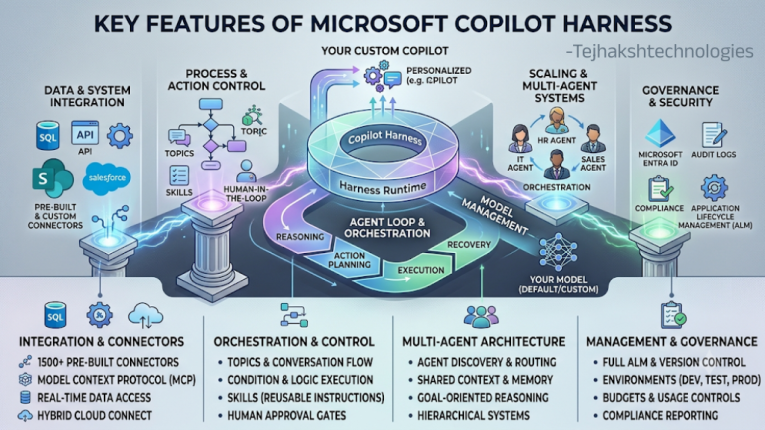
Key Features of Microsoft Copilot Harness
Microsoft’s announcement highlights several important capabilities that make this technology relevant to modern AI development.
A. Support for Multiple AI Models
Model flexibility is one of the most important features of the MCH.
Developers are not limited to building their applications around one AI model. They can work with supported model families and select suitable intelligence for different tasks.
This is valuable because AI technology changes rapidly. A model that performs exceptionally well today may be replaced by a better alternative tomorrow.
Multi-model support helps businesses adapt without constantly redesigning their entire AI infrastructure. .
B. Intelligent Model Orchestration
Model orchestration means coordinating different AI models and determining how they should be used within a workflow.
Imagine a software development agent that needs to understand a programming requirement, generate code, inspect errors, and prepare documentation.
Different stages may benefit from different model capabilities.
An orchestration layer provides the structure for managing these interactions.
This can help developers create more flexible AI-powered applications.
C. Tool Integration and Open Standards
AI agents become significantly more useful when they can interact with external tools.
Microsoft highlights support for open standards such as the Model Context Protocol (MCP), along with agent skills and plugins.
These capabilities help create connections between AI agents and the resources they need to perform tasks.
For example, an appropriately configured agent may work with business information, software development tools, or connected services.
Open interoperability is important because organizations often use several different software platforms. They need AI systems that can work within existing technology environments rather than forcing them to replace everything.
D. Managed Execution Environment
Developing an AI agent requires more than connecting an API to a language model.
Developers also need to manage execution, working context, tools, and the environment in which tasks take place.
Microsoft Copilot Harness provides a managed foundation for these operations through Microsoft Foundry.
Microsoft manages the agent loop and sandbox, while developers provide the instructions, skills, tools, and model choices.
This approach can reduce the amount of infrastructure that development teams need to build and maintain themselves.
E. Performance and Efficiency
Performance becomes especially important when AI agents perform long-running tasks or interact with multiple tools.
Microsoft says its engineering team has ported the harness runtime to Rust, with the objective of improving performance and reducing session overhead and time-to-first-token.
For developers, faster execution and efficient resource utilization can contribute to a better user experience.
The actual performance will still depend on the selected model, workload, configuration, and connected services.
How MCH Connects With GitHub Copilot
The technology has an interesting connection with GitHub.
According to Microsoft’s announcement, the Copilot Harness was developed by GitHub engineers and has been adopted across multiple Microsoft Copilot experiences.
These include:
- GitHub Copilot application.
- Copilot CLI.
- Visual Studio Code.
- Copilot Studio.
- Copilot Code and other Copilot experiences.
This is important because Microsoft is moving towards a more consistent technical foundation across its AI products.
Instead of maintaining completely separate execution systems for different Copilot experiences, a shared harness can help Microsoft improve and evolve its AI infrastructure more consistently.
For developers, this could mean more predictable agent experiences and access to improvements made across the broader Microsoft ecosystem.
It also highlights how software development platforms are becoming an important part of the future of agentic AI.
Why Microsoft Foundry Is Important for AI Agent Development
Microsoft Foundry plays a central role in making the Copilot Harness accessible to developers and enterprise customers.
It provides an environment for building and managing AI-powered applications and agents.
The availability of a managed harness through Foundry is particularly significant for teams that want to concentrate on application development rather than building every part of the underlying agent infrastructure.
Consider a startup developing an AI-powered customer support platform.
Without a managed execution foundation, its developers may need to spend considerable time coordinating model calls, handling tools, maintaining context, and managing execution environments.
With a managed harness, more of that infrastructure can be handled by the platform.
This allows the startup to concentrate on features that make its product different, such as customer knowledge, specialized instructions, business workflows, and user experience.
Microsoft’s Foundry announcement describes the Copilot Harness as a public-preview capability within Foundry Agent Service.
It also provides flexibility for developers who prefer different levels of control over their agent architecture.
The important point is that organizations can choose an approach based on the complexity and technical requirements of their applications.
Real-World Business Applications of Multi-Model AI Agents
The potential applications of MCH extend beyond software development.
Here are some practical areas where multi-model AI agents could create business value.
A. Customer Support Automation
Businesses receive customer questions through websites, emails, and other communication channels.
An AI agent could help understand customer requests, retrieve relevant information, and prepare responses using connected business tools.
With appropriate permissions and human review, repetitive support activities could become more efficient.
B. Digital Marketing Operations
Marketing teams regularly perform activities such as research, content planning, keyword analysis, reporting, and campaign monitoring.
AI agents could help coordinate these workflows.
For example, one stage could gather campaign data, another could analyse performance, and another could prepare a marketing report.
The final decisions and approval of published content can remain with the marketing team.
C. Software Development
Software development is one of the most promising areas for agentic AI.
An AI-powered development agent can assist with understanding requirements, exploring code, generating suggestions, reviewing errors, and preparing documentation.
Multi-model orchestration could make it easier to use different AI capabilities at different stages of the development process.
D. Business Data Analysis
Companies generate large amounts of information through sales systems, customer platforms, accounting software, and internal applications.
AI agents connected to authorized data sources could help organize information and prepare useful summaries.
Business owners could use these systems to understand trends, identify operational problems, and make better-informed decisions.
E. Enterprise Workflow Automation
Large organizations often have complex processes involving multiple teams and software systems.
AI agents could assist with document processing, internal research, information retrieval, and repetitive administrative workflows.
However, sensitive operations should always use appropriate access controls, audit mechanisms, and human approval.
What Makes Copilot Harness Different From a Traditional AI Chatbot?
There are several key differences between a traditional AI chatbot and an AI agent powered by a harness:
- Purpose: A traditional AI chatbot responds to user questions, while an AI agent works towards completing specific objectives.
- Task Execution: Chatbots mainly generate information and responses, whereas AI agents can perform actions using connected tools.
- Workflow Management: Traditional chatbots generally follow simple conversation patterns, while AI agents can manage complex, multi-step workflows.
- Tool Integration: Chatbots may have limited tool access, whereas AI agents can interact with configured applications, services, and external tools.
- Context Management: Traditional chatbots primarily focus on conversations, while AI agents can manage relevant instructions and context throughout task execution.
- Execution Environment: A traditional chatbot mainly generates answers, whereas an AI agent with a harness operates within a configured execution environment.
- Decision-Making: Chatbots primarily provide responses based on prompts, while AI agents can determine the next steps required to accomplish a given task.
- Main Focus: Traditional AI chatbots focus on answering questions, while AI agents focus on completing tasks and achieving defined outcomes.
Important Note: AI agents are not automatically more accurate or reliable than traditional chatbots. Their performance depends on the selected AI models, tools, instructions, configuration, and human supervision.
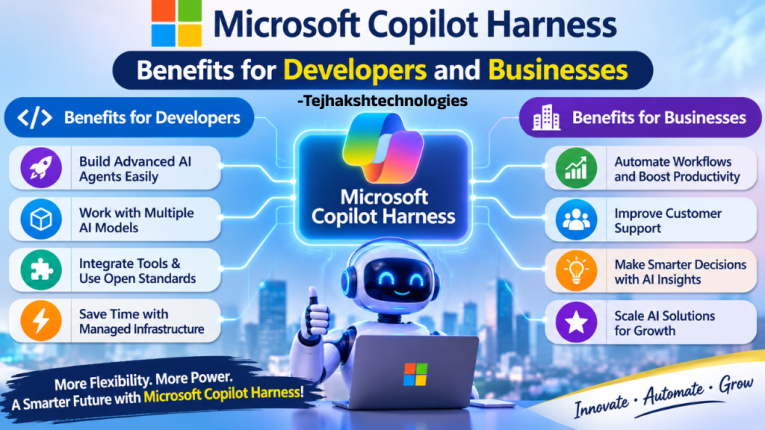
Benefits of Microsoft Copilot Harness for Developers and Businesses
The introduction of MCH could offer several practical advantages.
- Reduced infrastructure development: Developers can use a managed execution foundation instead of building every orchestration component from scratch.
- Greater model flexibility: Businesses can work with multiple supported AI models and adapt as new technologies become available.
- Improved development productivity: Engineering teams can spend more time building application-specific features and less time maintaining common agent infrastructure.
- Better workflow coordination: The harness provides an organized structure for handling instructions, context, tools, and multi-step execution.
- Scalability opportunities: A shared technology foundation can help organizations build AI applications for different use cases.
- Continuous improvements: Microsoft can improve its shared harness infrastructure, potentially benefiting the Copilot experiences and Foundry agents that use it.
These advantages could be especially useful for companies that want to introduce AI automation without maintaining a completely custom agent framework.
Challenges and Limitations to Consider
Although multi-model AI and agentic automation offer exciting possibilities, businesses should not assume that every process can immediately be automated.
There are several important considerations.
- Model selection: Different models have different strengths, costs, and limitations. Choosing the right model for each task remains important.
- Data security: Agents that access business information must operate with carefully configured permissions and authentication.
- Accuracy: AI systems can misunderstand instructions or generate incorrect results. Important outputs should be validated.
- Operational costs: Using multiple models, tools, and execution resources can increase expenses. Businesses should monitor usage and optimize workflows.
- Human supervision: High-impact decisions should retain appropriate human oversight.
- Integration complexity: Existing business software may require additional configuration before agents can work with it effectively.
A successful AI agent strategy is not simply about selecting a powerful model. It involves combining reliable technology, good data, clear instructions, suitable tools, and effective governance.
Conclusion
Microsoft Copilot Harness is an important step towards making Artificial Intelligence more useful and powerful.
It brings together multiple AI models, tools, and technologies to help AI agents perform different tasks more easily and efficiently.
For developers, it makes building advanced AI agents easier by providing the necessary infrastructure. For businesses, it opens new opportunities to automate daily work, improve productivity, manage customer support, and develop smarter applications.
The biggest advantage is that businesses no longer have to depend on just one AI model. They can use different AI models and tools according to their requirements.
As AI technology continues to grow, tools like Microsoft Copilot Harness could change the way people work, develop software, and manage businesses.
Leave a Comment