- October 2, 2026
- Tejhaksh
- 0 Comments
- Uncategorized
Vue.js vs React.js: Key Differences, Performance, and Which to Choose

Choosing the right JavaScript technology is important when building a modern website or web application. Vue.js and React.js are two popular technologies used by developers to create fast, interactive, and user-friendly websites and applications.
Both Vue.js and React.js are commonly used for building interactive user interfaces, single-page applications (SPAs), dashboards, e-commerce websites, and modern web applications. However, they have different features, syntax, and development approaches.
So, Vue js vs React js—which one is better? There is no single answer because the right choice depends on your project requirements, development team’s experience, application size, performance needs, and long-term goals.
In this guide, we will explain what Vue.js is, what Vue.js is used for, what React.js is, the difference between ReactJS and Vue.js, their performance, syntax, features, advantages, and which one you should choose for your project.
What Is Vue.js?
Vue.js is an open-source JavaScript framework used to build modern websites and web applications. It helps developers create interactive, responsive, and user-friendly interfaces with less complexity.
One of the main features of Vue.js is its component-based architecture. This means developers can divide a website or application into small, reusable parts called components. Each component can handle a specific part of the interface and can be used in different places when needed.
For example, a web application can have separate Vue.js components for:
- Navigation menus
- Login and registration forms
- Product cards
- Shopping carts
- Search bars
- User profiles
- Dashboards
- Notifications
These components can be created and managed separately, which makes the code easier to understand, update, and maintain.
Another reason developers use Vue.js is its simple and flexible approach. Developers who already know HTML, CSS, and JavaScript can get started with Vue.js relatively easily.
Overall, Vue.js is a useful choice for building interactive websites, single-page applications (SPAs), dashboards, e-commerce websites, and modern web applications.
Vue.js Key Features
Vue.js comes with several useful features that make it easier for developers to build modern and interactive websites. Some of the main Vue.js features include:
- Component-Based: Build websites using small, reusable components.
- Reactive Data: The interface updates automatically when data changes.
- Simple Syntax: Easy-to-understand syntax for developers.
- Reusable Components: Use the same components in different parts of an app.
- Routing Support: Create multiple pages and views in web applications.
- State Management: Manage application data efficiently.
- SPA Support: Build fast and interactive Single-Page Applications.
- Easy Integration: Add Vue.js to existing websites and applications.
What Is Vue.js Used For?
Vue.js is mainly used to create interactive and modern websites and web applications. It helps developers build user-friendly interfaces without making the code too complicated.
1. Single-Page Applications (SPAs)
Vue.js is commonly used to build Single-Page Applications, where users can move between different sections without fully reloading the page.
Examples include:
- Admin panels
- Customer dashboards
- SaaS applications
- Online portals
- Project management tools
2. Interactive Websites
Vue.js can add interactive features such as:
- Search bars
- Product filters
- Dynamic forms
- Shopping carts
- Interactive menus
3. E-Commerce Websites
Vue.js can be used to create product pages, filters, shopping carts, and other interactive features for e-commerce websites.
4. Dashboards
Its reusable components make Vue.js useful for building dashboards and admin panels with charts, tables, forms, and reports.
5. Progressive Web Apps
Vue.js can also be used to build Progressive Web Applications (PWAs) that provide app-like experiences through the web.
Overall, Vue.js is a flexible option for building modern, interactive, and responsive web applications.
What Is React.js?
React.js, also known as React, is an open-source JavaScript library used to build interactive and modern user interfaces. It was originally developed by Facebook (now Meta) and is widely used for front-end web development.
React uses a component-based approach, which means developers can divide a website or application into small, reusable components. This makes the code easier to manage, update, and maintain.
For example, a website can have separate components for:
- Header and navigation
- Login forms
- Product cards
- Shopping cart
- User profiles
- Dashboards
- Footer
Each component can have its own design and functionality while working together to create a complete web application.
React.js Is Commonly Used For:
- Modern web applications
- Single-Page Applications (SPAs)
- E-commerce websites
- SaaS applications
- Dashboards and admin panels
- Social media platforms
- Interactive websites
Overall, React.js is a flexible and powerful choice for developers who want to build fast, interactive, and reusable user interfaces.
Difference Between React.js and Vue.js
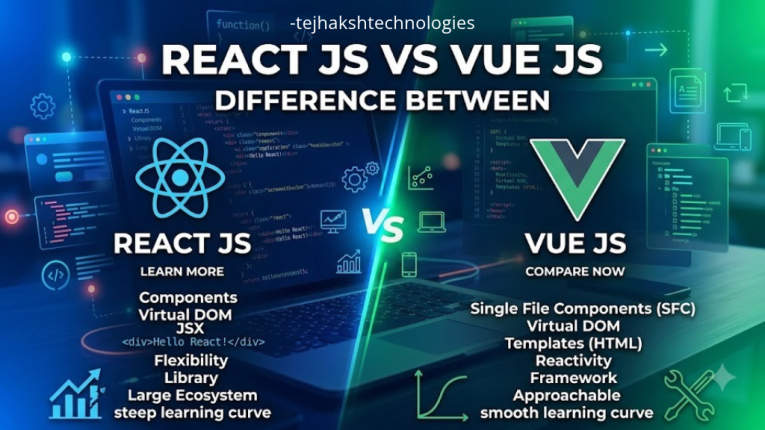
ReactJS and Vue.js are both popular technologies for front-end web development. They can be used to create interactive websites and web applications, but they differ in areas such as syntax, performance, learning curve, components, and ecosystem.
1. Vue js vs React js Syntax
Syntax is one of the main differences between Vue.js and React.js.
Vue.js uses HTML-based templates along with JavaScript. This approach can feel familiar to developers who already know HTML, CSS, and JavaScript.
React.js uses JSX, which allows developers to write HTML-like code directly inside JavaScript.
Both approaches have their own benefits. Developers who prefer a traditional HTML-style structure may find Vue.js comfortable, while those who like combining UI and JavaScript logic may prefer React’s JSX.
2. Performance: Vue js vs React js
Performance is an important factor when choosing a front-end technology. Both Vue.js and React.js can be used to build fast and responsive web applications.
However, the actual performance of an application depends on several factors, including:
- Application structure
- Number of components
- Rendering approach
- JavaScript bundle size
- API response time
- State management
- Code optimization
- Caching
- Server performance
Because of this, it is difficult to say that one is always faster than the other. Good development practices and proper optimization can have a major impact on the final performance of a website or application.
3. Learning Curve
The learning curve is another important difference between Vue.js and React.js.
Vue.js can be easier to understand for beginners because it uses familiar HTML-based templates and standard web development concepts.
React.js requires developers to learn concepts such as:
- JSX
- Components
- Props
- State
- Hooks
- Rendering
- State management
Once these concepts are understood, React can be used to build complex and interactive applications.
The easier option depends on the developer’s existing JavaScript knowledge and preferred way of writing code.
4. Component-Based Development
Both Vue.js and React.js use components to build user interfaces.
A component is a reusable building block of an application. For example, an e-commerce website can use different components for:
- Product cards
- Search bars
- Login forms
- Shopping carts
- Navigation menus
Instead of writing the same code repeatedly, developers can create a reusable component and use it wherever needed.
This approach helps keep the code organized, reusable, and easier to maintain.
5. Ecosystem and Community
The ecosystem is also important when choosing between ReactJS and Vue.js.
React.js has a large ecosystem with many libraries, development tools, tutorials, UI libraries, and third-party integrations.
Vue.js also has a strong ecosystem with tools and libraries for common requirements such as routing, state management, testing, and application development.
Before choosing a technology, developers should check whether it supports the tools their project needs.
For example, a large web application may require:
- Authentication
- Payment integration
- API integration
- State management
- Analytics
- Testing
- Routing
- UI component libraries
Choosing a technology with suitable tools and libraries can make development and long-term maintenance easier.
Advantages of Vue.js
Vue.js has several features that make it useful for modern web development.
1. Easy to Understand
Vue.js uses HTML, CSS, and JavaScript in a simple structure. This makes it easier for developers who already know basic web development.
2. Reusable Components
Developers can build individual UI elements, such as buttons, menus, product cards, and forms, as reusable components. These components can then be used in multiple areas of the application, helping keep the code organized and reducing repetition.
3. Flexible to Use
Vue.js can be added to a small part of an existing website or used to build a complete web application. Developers do not always need to rebuild the entire website.
4. Reactive Interface
Vue.js updates the interface automatically whenever the underlying data changes, making websites more interactive and responsive.
5. Good for Different Projects
Vue.js can be used for small website features as well as larger web applications, depending on the project requirements.
Advantages of React.js
React.js is also widely used for building modern and interactive websites and web applications.
1. Reusable Components
React.js allows developers to create reusable components. This helps reduce repeated code and makes applications easier to manage.
2. JSX
React uses JSX, which allows developers to write HTML-like UI code directly with JavaScript. This makes it easier to connect the user interface with application logic.
3. Large Ecosystem
React has a large ecosystem of libraries, tools, tutorials, and third-party solutions. Developers can find many resources to help build their applications.
4. Flexible Architecture
React can work with different tools for routing, state management, API integration, data fetching, and other application needs.
5. Good for Complex Applications
React.js works well for building large and interactive web applications. With a structured architecture and proper development practices, it can support complex applications and their growing requirements.
Vue.js vs React.js: Which Is Better?
Both are popular technologies for building modern websites and web applications.
The right choice depends on your project requirements, team experience, and development needs.
Consider Vue.js If You Prefer:
- Simple Template-Based Development: Vue.js uses HTML-based templates that can be easy to understand.
- Progressive Framework: Vue.js can be used for small features as well as complete web applications.
- Easy Learning: Developers with basic HTML, CSS, and JavaScript knowledge may find Vue.js easier to get started with.
- Flexible Adoption: Vue.js can be added to specific parts of an existing website without rebuilding the entire application.
- Vue Ecosystem: Vue provides useful tools for routing, state management, and application development.
Consider React.js If You Prefer:
- JSX: React uses JSX, which allows developers to write UI code together with JavaScript logic.
- Library-Based Approach: React can be combined with different libraries and tools based on project needs.
- Large Ecosystem: React has many libraries, development tools, tutorials, and third-party solutions.
- Flexible Architecture: Developers can choose different tools for routing, state management, data fetching, and other requirements.
- Reusable Components: React makes it easy to create reusable components for modern and interactive applications.
The most important factor is not simply which technology is more popular. The technology should match the project requirements, developer expertise, maintenance plans, scalability needs, and existing technology stack.
Which One Should You Choose?
Before choosing Vue.js or React.js, ask the following questions:
1. What type of application are you building?
A small interactive website may have different requirements from a large SaaS platform.
2. What does your development team already know?
Existing developer experience can significantly reduce development time and training requirements.
3. What libraries do you need?
Check whether your required tools, APIs, UI libraries, authentication solutions, and integrations work well with your selected technology.
4. What are your long-term maintenance requirements?
A project may remain in development for years. Consider documentation, developer availability, ecosystem maturity, and maintainability.
5. What are your performance requirements?
Define actual performance requirements rather than choosing a technology based only on general claims about speed.
Conclusion
Vue.js vs React.js is a common topic in modern web development. Both can be used to build fast, interactive, and scalable websites and web applications.
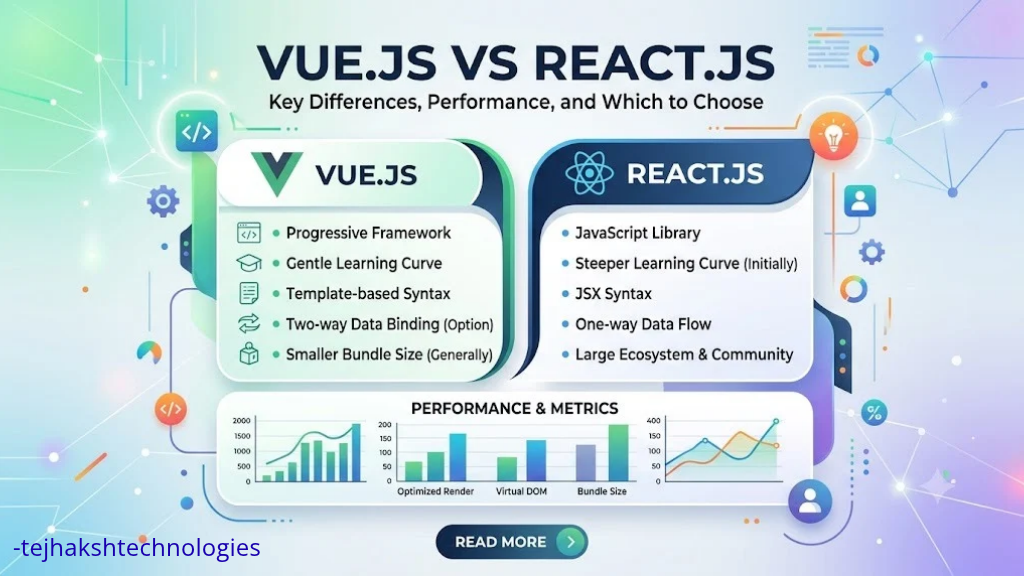
Vue.js is a progressive framework that uses a simple template-based approach and reactive features. React.js is a popular UI library that uses JSX and provides a large ecosystem of tools and libraries.
When choosing between Vue.js and React.js, consider your project requirements, team experience, project size, required tools, performance needs, and long-term maintenance.
Instead of choosing a technology only because it is popular, focus on what works best for your project. With good planning, clean code, and the right architecture, both Vue.js and React.js can be used to build effective web applications.

Leave a Comment