Tejhaksh Technologies is the Website designing & Digital Marketing company based in Neemuch, established in 2020 providing Website design, Website development, Logo design, Domain Registration, Web hosting, Android App Development, eCommerce web development, Search Engine Optimization, Bulk SMS etc. We have good experience in developing different platform websites and we keep our eye on the latest technologies to implement on the website for better conversion and user experience.
Businesses today rely on technology to manage customers, employees, sales, finances, inventory, and daily operations. As a company grows, using spreadsheets and separate tools for every task can become difficult. This is where business management software such as CRM and ERP systems can make a big difference.
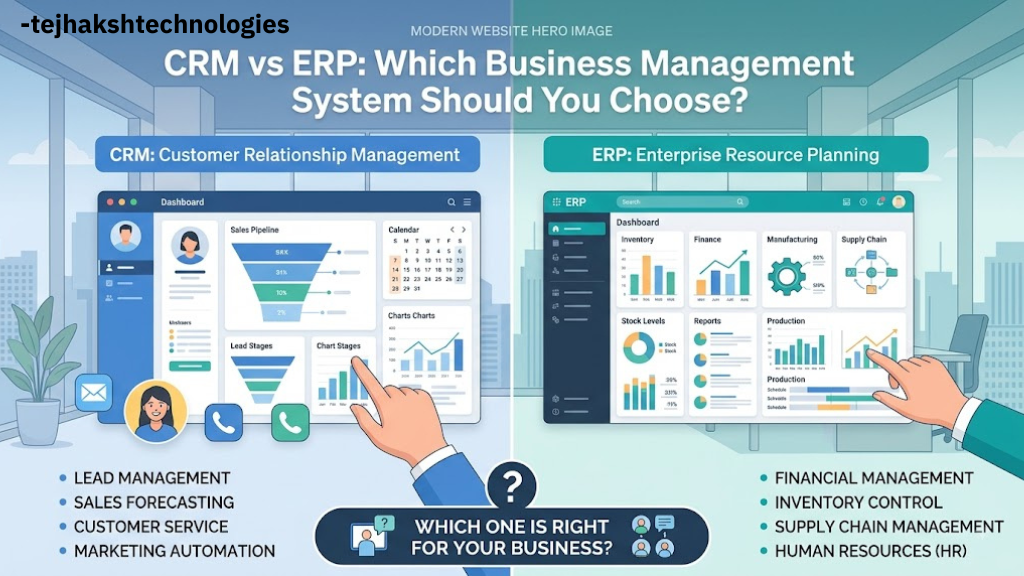
But what is the difference between CRM vs ERP? Which system does your business actually need? Should you choose CRM, ERP, or both?
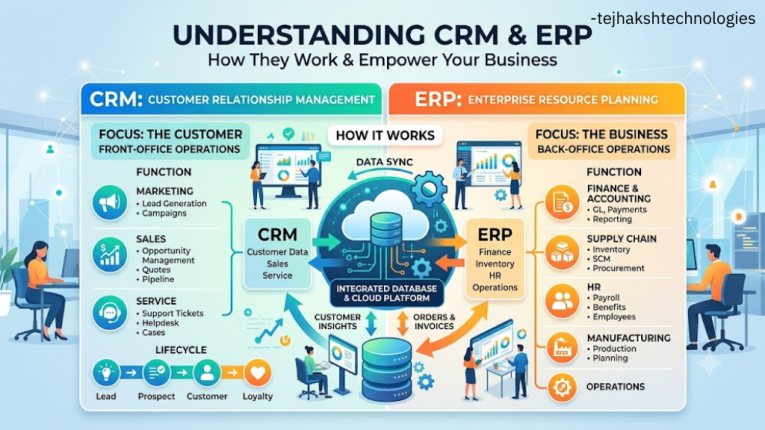
A CRM (Customer Relationship Management) system mainly focuses on customers, leads, sales, and relationships. An ERP (Enterprise Resource Planning) system focuses on broader business operations such as finance, inventory, purchasing, production, supply chain, and human resources.
In this guide, we will explain what CRM and ERP systems are, their key features, similarities, differences, benefits, and how to decide which solution is right for your business.
CRM stands for Customer Relationship Management. A CRM system is software that helps businesses manage customer information, sales, leads, and communication in one place.
The main purpose of a CRM is to help businesses stay organized and build better relationships with their customers. It makes it easier for sales, marketing, and customer support teams to access important customer information and work together.
Without a CRM, businesses may keep customer details in spreadsheets, notebooks, emails, or different software. This can make information difficult to find and increase the chances of missing important follow-ups.
With a CRM, important customer information can be stored and managed in one central system.
What Can a CRM System Manage?
A CRM can help businesses keep track of:
A CRM system collects and organizes customer information in one place, making it easy for employees to find, update, and manage customer details.
For example, when a potential customer contacts a business, the sales team can add the customer’s information to the CRM. They can also record the customer’s requirements, schedule a follow-up, and keep track of every conversation.
As the customer moves through the sales process, the CRM helps the sales team see the current status. For example, they can check whether the customer is interested, has asked for a quotation, or has already made a purchase.
A CRM can provide timely follow-up reminders and useful sales reports, helping businesses stay organized and make sure they don’t miss valuable customer opportunities.
In simple words, a CRM helps businesses manage customer information, track sales, follow up with leads, and build better customer relationships.
ERP stands for Enterprise Resource Planning. An ERP system is business management software that connects and manages different areas of an organization through a centralized system.
While CRM mainly focuses on customers and sales, ERP covers a much wider range of business operations.
Depending on the business and ERP solution, it may manage:
The main purpose of ERP is to help different departments work with connected and consistent information.
An ERP system connects different departments and business processes in one place.
For example, when a company receives a customer order, the sales team enters the order into the ERP system. The system can then update the inventory, create financial records, and share the order details with the warehouse and other relevant departments.
This means employees do not have to enter the same information into multiple systems. Everyone can work with the same updated data.
In simple terms, an ERP helps businesses connect departments, reduce manual work, avoid duplicate data, and manage daily operations more efficiently.
CRM and ERP are both business management systems, but they are designed for different purposes. Here are the main differences in simple points:
1. Main Focus
CRM: Focuses on customers, sales, and relationships.
ERP: Focuses on overall business operations and resources.
2. Main Users
CRM: Mainly used by sales, marketing, and customer support teams.
ERP: Commonly used by finance, HR, inventory, operations, production, and purchasing teams.
3. Customer Management
CRM: Provides detailed tools for managing customers and leads.
ERP: May include customer management, but it is not usually the main focus.
4. Sales Management
CRM: Helps manage leads, sales opportunities, and follow-ups.
ERP: Manages sales orders and related business processes.
5. Inventory Management
CRM: Usually has limited inventory features or connects with other systems.
ERP: Provides comprehensive inventory and stock management.
6. Accounting and Finance
CRM: May offer basic financial features or integrate with accounting software.
ERP: Provides broader tools for accounting, finance, invoices, expenses, and financial reporting.
7. Manufacturing and Supply Chain
CRM: Usually has limited features in these areas.
ERP: Can manage production, purchasing, inventory, and supply chain processes.
8. Marketing
CRM: Helps manage marketing campaigns and customer engagement.
ERP: Marketing is generally not its primary function.
9. Customer Support
CRM: Helps manage customer questions, complaints, and support requests.
ERP: Customer support is usually not a main focus.
10. Main Goal
CRM: To improve customer relationships, sales, and customer service.
ERP: To improve business operations, resource management, and overall efficiency.
Choosing between CRM and ERP depends on your business needs.
Choose CRM If:
Your main focus is customers and sales. A CRM helps manage leads, customer relationships, follow-ups, sales pipelines, and communication.
Best for: Sales companies, service businesses, startups, consultants, real estate, and e-commerce businesses.
Choose ERP If:
Your main focus is business operations. An ERP helps manage inventory, finance, purchasing, production, warehousing, and supply chain.
Best for: Manufacturing, retail, wholesale, distribution, and businesses with complex operations.
In simple terms:
CRM = Customers & Sales
ERP = Operations & Resources
Both CRM and ERP systems help businesses organize their work, but they focus on different areas. CRM mainly focuses on customers and sales, while ERP focuses on business operations and resources.
1. Contact Management
Stores customer names, contact details, and other important information in one place.
2. Lead Management
Helps businesses collect, organize, and track potential customers.
3. Sales Pipeline Management
Allows sales teams to see the progress of each lead or sales opportunity.
4. Follow-Up Management
Helps schedule reminders and follow-ups so that important leads are not missed.
5. Marketing Management
Helps businesses manage marketing campaigns and track customer responses.
6. Customer Support
Makes it easier to manage customer questions, complaints, and support requests.
7. Reports and Analytics
Provides useful reports on sales, leads, customers, and overall sales performance.
1. Financial Management
Helps manage accounts, expenses, payments, invoices, and financial reports.
2. Inventory Management
Tracks stock levels, products, warehouses, and inventory movement.
3. Purchasing Management
Helps manage suppliers, purchase orders, and procurement activities.
4. Sales and Order Management
Helps manage customer orders, invoices, deliveries, and sales-related processes.
5. Manufacturing Management
Helps businesses manage production, materials, planning, and manufacturing processes.
6. Supply Chain Management
Connects purchasing, inventory, production, and delivery processes.
7. Human Resource Management
Some ERP systems help manage employee records, attendance, payroll, and other HR activities.
8. Business Reporting
Provides reports that help managers understand the company’s financial and operational performance.
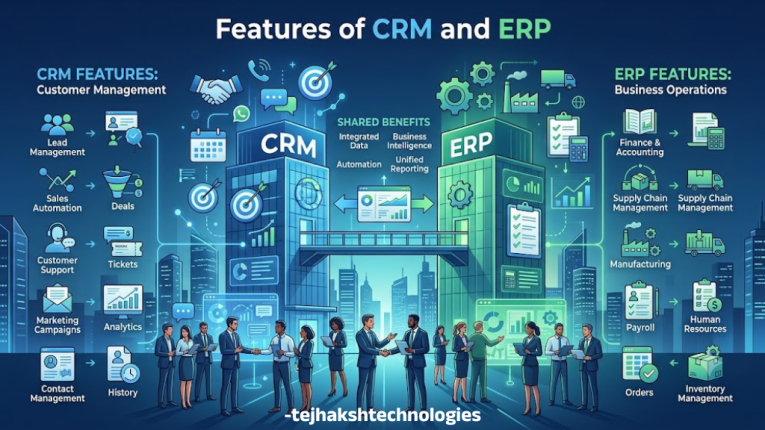
Although CRM and ERP have different purposes, they share several important features. Both systems help businesses organize information, reduce manual work, and improve overall efficiency.
1. Centralize Business Information:
Both CRM and ERP store important business data in one central system, making it easier to access and manage.
2. Improve Efficiency:
They can automate routine tasks and reduce manual work, helping employees save time and work more efficiently.
3. Provide Reports:
Both systems offer reports and dashboards that help managers understand business performance and make better decisions.
4. Reduce Duplicate Data:
By keeping information in one system, businesses can reduce repeated data entry and avoid maintaining the same information in multiple places.
5. Support Business Growth:
As a business grows, managing information manually becomes more difficult. CRM and ERP can help businesses manage larger volumes of data and processes more effectively.
6. Connect With Other Software:
Modern CRM and ERP systems can often integrate with websites, payment systems, communication tools, accounting software, and other business applications.
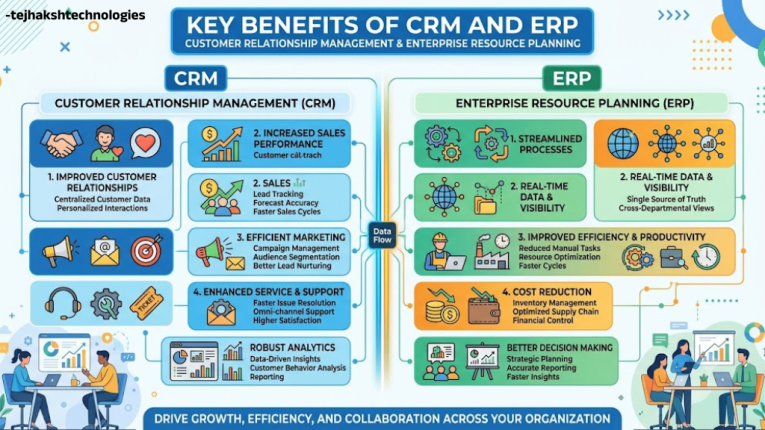
Both CRM and ERP systems help businesses stay organized, save time, and improve efficiency. However, they focus on different areas of business management.
A CRM system helps businesses manage customers, leads, sales, and communication more effectively.
An ERP system helps businesses manage operations, resources, finance, inventory, and other important processes.
Yes, a business can use both CRM and ERP because they handle different areas of the business.
For example, the CRM can manage a new lead, customer communication, sales follow-ups, and quotations. Once the customer places an order, the ERP can handle inventory, invoicing, purchasing, production, and delivery.
When CRM and ERP are connected, information can flow smoothly from lead to sale, order, delivery, and payment.
Small businesses may not need a large ERP system from the beginning. The right choice depends on the business requirements and daily operations.
If the main focus is sales and customer management, a CRM can be a good starting point. It can help manage leads, customer details, follow-ups, and sales.
On the other hand, a small manufacturing, retail, or distribution business with complex inventory, accounting, or purchasing needs may benefit more from an ERP.
Before choosing a CRM or ERP, consider these points:
Choose a system that fits your business needs today and supports your future growth.
Choosing between CRM and ERP depends on your business needs, not just the number of features a software offers.
If your main focus is customers, sales, leads, and follow-ups, a CRM may be the right choice. If you need to manage finance, inventory, purchasing, production, and other operations, an ERP may be more suitable.
Growing businesses can also use both CRM and ERP to manage customers and business operations more effectively.
Before choosing a system, understand your business needs, compare available options, and select software that can support your business today and grow with you in the future.
Leave a Comment