Tejhaksh Technologies is the Website designing & Digital Marketing company based in Neemuch, established in 2020 providing Website design, Website development, Logo design, Domain Registration, Web hosting, Android App Development, eCommerce web development, Search Engine Optimization, Bulk SMS etc. We have good experience in developing different platform websites and we keep our eye on the latest technologies to implement on the website for better conversion and user experience.
In today’s world, the increasing use of the internet, social media, online shopping, and smart devices generates vast amounts of data every day. The volume of this data is so immense that handling and analyzing it using traditional methods becomes difficult. This creates a need for Big Data technology, which facilitates the easy storage, processing, and analysis of large and complex datasets.
Big Data technology has completely transformed the way businesses and various industries operate. It enables companies to better understand customer preferences, make informed decisions, improve their services, and stay ahead of the competition in the market. Today, Big Data is being widely utilized across sectors such as healthcare, banking, retail, education, and manufacturing.
In this article, we will explore—in simple terms—what Big Data technology is, how it works, its key types and features, the tools used, its benefits, the challenges involved in its implementation, and the future significance of Big Data.
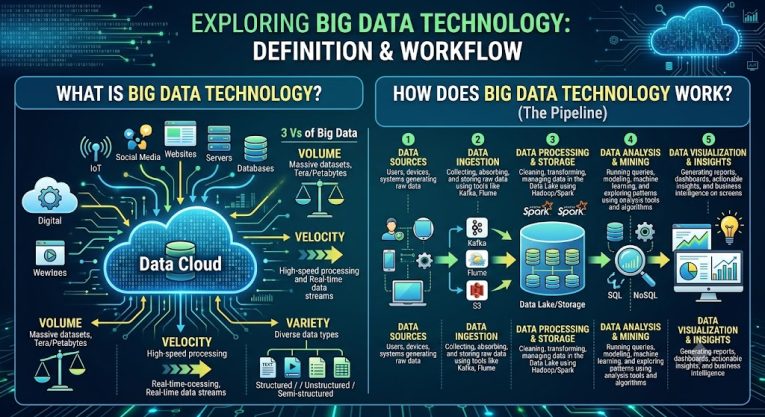
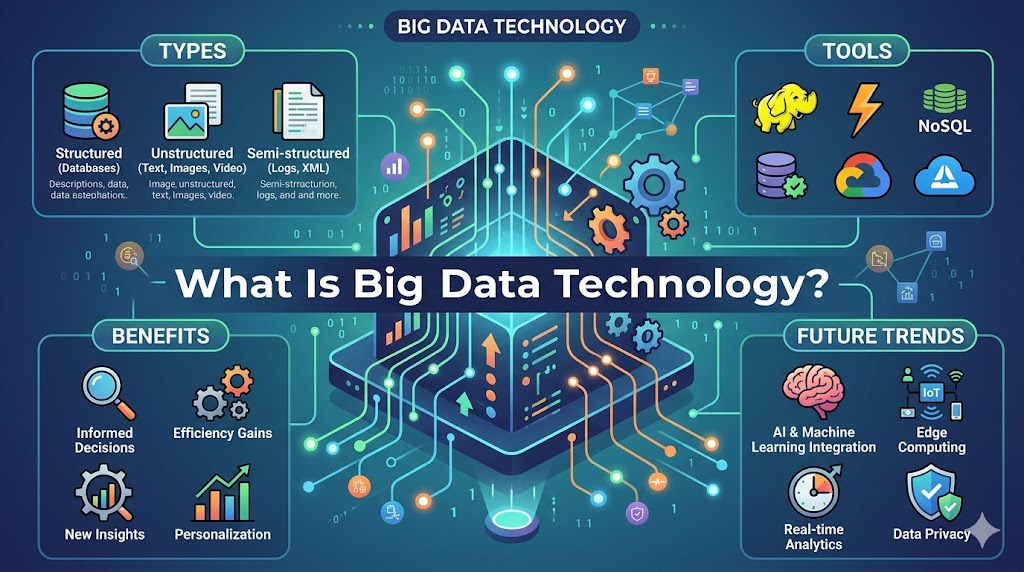
Big Data technology is a set of tools and techniques that help collect, store, process, and analyze vast amounts of data. Big Data technology is employed when the volume of data exceeds the handling capacity of standard computer systems.
Big Data is not limited merely to the size or volume of data; it also encompasses the speed at which data is generated and the variety of formats in which it is available.
Examples of Big Data
Big Data technology helps companies effectively analyze vast amounts of available information. Through this, companies can gain a better understanding of their customers, the market, and their business operations. With the help of Big Data, companies can:
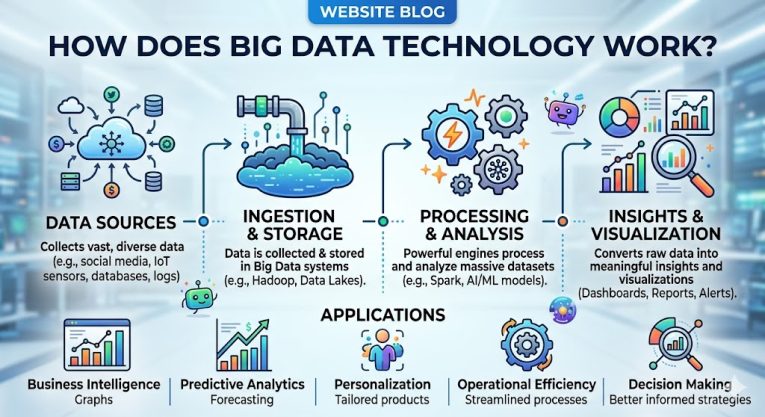
Big data technology operates in several stages to handle vast amounts of data and derive useful insights from it. The process begins with data collection and extends to analysis and the extraction of significant conclusions. Let us understand how big data works.
First, data is gathered from various sources. This data is generated continuously and in massive volumes.
Key data sources:
The collected data is stored securely. Since the volume of data is immense, specialized storage systems are used instead of conventional databases.
Key storage technologies:
The stored data undergoes processing to prepare it for analysis. During this stage, the data is organized and cleaned.
Popular processing tools:
The processed data is analyzed to uncover valuable information and patterns. This helps companies make better decisions.
Key analysis methods:
Finally, the analyzed data is presented in the form of graphs, charts, reports, and dashboards. This makes complex information easy to understand and facilitates important business decisions.
To understand Big Data, it is crucial to know its key characteristics. These are the features that distinguish Big Data from conventional data. Typically, the characteristics of Big Data are known as the “5 Vs of Big Data.”
Volume refers to the quantity of data. Nowadays, companies collect massive amounts of data daily from millions of users, websites, mobile apps, and smart devices.
The volume of this data is so immense that handling it with standard systems becomes difficult; therefore, specialized Big Data technologies are required.
Data volume is usually measured in the following units:
Terabytes (TB)
Petabytes (PB)
Exabytes (EB)
Velocity is the speed at which data is generated and analyzed in real time. Today, data is being generated continuously and at a very high speed.
Examples:
Companies need to analyze this data rapidly to make timely and accurate decisions.
Big Data is not of just one type; it is available in many different formats.
Structured Data
This exists in an organized format, such as:
Semi-Structured Data
This is partially organized, such as:
Unstructured Data
This constitutes the largest volume of data, such as:
Veracity relates to the quality and accuracy of the data. If the data is incorrect or incomplete, the results derived from it may also be inaccurate. Therefore, companies ensure that the data is:
The most important objective of Big Data is to derive useful information from the data. Merely collecting data is not enough; creating value for the business from it is essential.
With the help of Big Data, companies can:
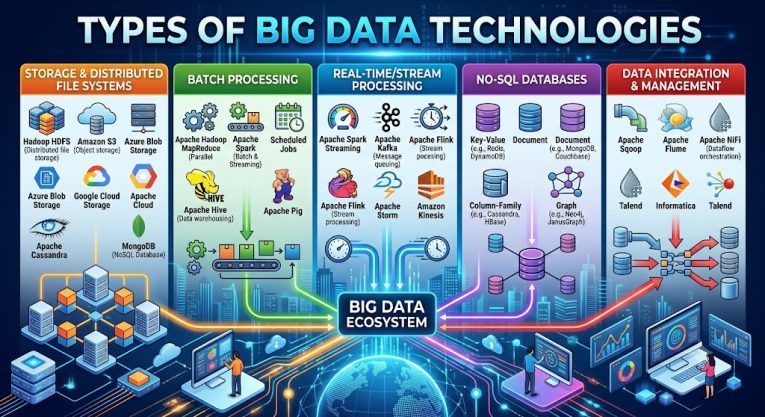
Various technologies are employed to handle big data effectively. Each technology serves a specific function—such as storing, processing, or analyzing data, or integrating data from diverse sources. Let us explore the key types of big data technologies.
When dealing with massive volumes of data, specialized storage technologies are used to store it securely and systematically. These technologies facilitate the handling of large datasets and ensure quick access whenever needed.
Key Examples:
Hadoop HDFS
Amazon S3
Google Cloud Storage
Data must be processed to become useful. Data processing technologies rapidly handle large volumes of data, preparing it for analysis.
Key Examples:
Apache Hadoop
Apache Spark
Apache Storm
Data often resides in disparate sources. Data integration technologies help consolidate and organize data from these various sources into a single location.
Key Examples:
Apache NiFi
Talend
Informatica
These technologies are used to analyze data and derive valuable information and business insights. They enable companies to make informed decisions and formulate future strategies.
Key Examples:
Tableau
Microsoft Power BI
SAS Analytics
These technologies learn from data to predict future possibilities and facilitate smart decision-making. Today, machine learning and artificial intelligence are utilized in most modern big data projects.
Key Examples:
TensorFlow
Scikit-Learn
PyTorch
Various modern technologies and tools are employed to handle, process, and analyze big data. These technologies enable companies to extract valuable insights from vast amounts of data and make better decisions. Let us explore some popular big data technologies.
Apache Hadoop is one of the most popular big data technologies in the world. It is used to store and process massive volumes of data.
Key Features:
Apache Spark is a fast and powerful data processing framework. It can process data much faster than Hadoop.
Key Advantages:
Apache Kafka is used for real-time data streaming. It facilitates the immediate processing of continuous data streams.
Key Use Cases:
Apache Hive is a data warehouse tool that allows users to run SQL-like queries on big data.
Key Benefits:
Apache Flink is specifically developed for real-time data processing and stream analytics.
Key Features:
MongoDB is a popular NoSQL database designed specifically to store large volumes of unstructured data.
Key Advantages:
A variety of tools and technologies are used to effectively store, process, and analyze big data. These tools help businesses make sense of vast amounts of data, derive valuable insights, and make better decisions. Let us explore some of the key big data tools and technologies.
Data collection tools are used to gather data from various sources. They are capable of handling data in real-time and at a massive scale.
Popular data collection tools:
Apache Kafka
Apache NiFi
Apache Flume
Specialized storage tools are used to store large volumes of data securely and systematically.
Key data storage tools:
Hadoop HDFS
Apache Cassandra
MongoDB
Amazon S3
Data processing tools rapidly process large volumes of data, preparing it for analysis.
Popular data processing tools:
Apache Spark
Hadoop MapReduce
Apache Storm
These tools are used to analyze data and derive actionable business insights.
Key data analytics tools:
Tableau
Microsoft Power BI
QlikView
With their help, data can be easily understood through charts, graphs, and dashboards.
Machine learning tools learn from data to predict future outcomes and assist in making smart decisions.
Popular machine learning tools:
Today, most companies use cloud platforms because they offer greater flexibility, security, and scalability.
Amazon Web Services (AWS)
AWS provides businesses with a range of powerful services for data storage, processing, and analytics.
Microsoft Azure
Azure offers advanced data analytics, machine learning, and artificial intelligence capabilities.
Google Cloud Platform (GCP)
Google Cloud Platform is a popular platform for big data analytics, AI, and machine learning projects.
Big Data has become a vital resource for businesses. It enables companies to analyze vast amounts of data to make better decisions, understand customers, and enhance business effectiveness. Let us explore the key benefits of Big Data.
1. Facilitates Better Decision-Making
Big Data provides companies with accurate, real-time information, allowing them to make informed business decisions based on facts. This reduces the likelihood of making erroneous decisions.
2. Improved Customer Experience
With the help of Big Data, companies can understand customer preferences, needs, and behaviors. This enables them to offer more personalized and superior services.
Examples:
3. Increased Efficiency and Productivity
Big Data helps identify inefficiencies and bottlenecks in business processes. This allows tasks to be executed faster, more simply, and more effectively.
4. Fraud Detection
Banks and financial institutions use Big Data to detect suspicious transactions and fraudulent activities, thereby enhancing financial security.
5. Cost Reduction
Proper data management helps companies cut unnecessary expenses and optimize resource utilization, leading to reduced costs.
6. Competitive Advantage
Big Data enables companies to quickly identify emerging market trends and shifting customer needs, helping them stay ahead of the competition.
7. Predicting Future Trends
With the help of Big Data and predictive analytics, companies can forecast future possibilities and market demand, enabling the formulation of better strategies.
8. Improved Risk Management
Big Data helps identify potential risks and plan solutions in a timely manner, thereby protecting the business from losses.
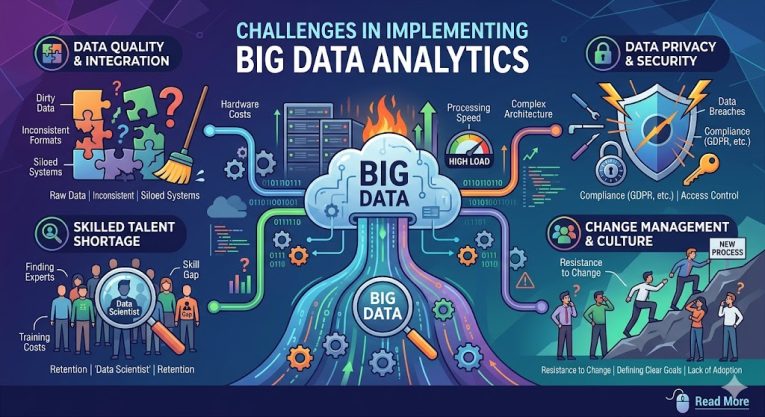
While big data analytics offers numerous benefits to businesses, its implementation also presents significant challenges.
1. Data Security
Securing vast amounts of sensitive data is a major challenge. It requires robust encryption, access controls, and cybersecurity measures.
2. Data Privacy
Companies must ensure the protection of customers’ personal information and comply with regulations regarding data privacy.
3. High Cost
Big data infrastructure, cloud services, and technical resources entail significant expenses, which can be challenging for small businesses.
4. Data Quality
Inaccurate, incomplete, or outdated data can lead to erroneous results; therefore, ensuring data accuracy and currency is essential.
5. Lack of Skilled Professionals
The demand for data scientists, data engineers, and big data experts is constantly rising, yet a shortage of qualified professionals remains a significant challenge.
6. Data Integration
Consolidating and organizing data from diverse sources can be a complex process.
7. Scalability
As data volumes grow, systems must be upgraded and scaled to maintain speed and performance.
The importance of Big Data is steadily growing alongside technological advancements. In the future, Big Data—combined with Artificial Intelligence (AI), machine learning, and automation—will make businesses smarter and more effective.
Key future trends in Big Data:
In short, the future of Big Data is set to become even more powerful and useful through its integration with AI, cloud computing, automation, and advanced analytics technologies.
In today’s digital era, big data technology has become a vital tool for businesses and organizations. It facilitates the collection, storage, processing, and analysis of vast amounts of data, enabling companies to make better decisions and provide superior services to their customers.
With the help of big data, businesses can understand customer needs, identify market trends, and enhance operational efficiency. Modern tools such as Hadoop, Spark, Kafka, and various cloud platforms assist in effectively managing data and deriving valuable insights from it.
Although implementing big data entails certain challenges—such as data security, costs, and technical complexities—its benefits far outweigh these hurdles. This is why an increasing number of companies worldwide are adopting big data technologies.
In the future, the importance of big data will grow further with the advancement of technologies like Artificial Intelligence (AI), machine learning, cloud computing, and real-time analytics. Businesses that learn to effectively leverage big data today will be better positioned to become successful, competitive, and innovative in the future.
Leave a Comment