

- August 10, 2026
- Tejhaksh
- 0 Comments
- Mobile Advertising, Uncategorized
What Is Mobile Advertising? Definition, How It Works, Types, and Industry Examples
Today, mobile phones have become an essential part of how we live, work, and communicate. People use smartphones and tablets for a variety of tasks, such as searching for information online, watching videos, shopping, communicating with friends and family, using social media, and researching different brands.
Given the rising usage of mobile devices, businesses are also leveraging them to reach customers. Consequently, the trend of mobile advertising—displaying advertisements on mobile devices—is growing rapidly.
But what exactly is mobile advertising? How does it work? What are the different types of mobile ads? What are the various models and examples? And most importantly, what is the difference between mobile advertising and mobile marketing?
In this simple guide, we will explore the answers to all these questions. Here, we will explain the meaning of mobile advertising, its types, how it works, key models, examples, advantages and disadvantages, as well as the distinction between mobile advertising and mobile marketing.
What is Mobile Advertising?
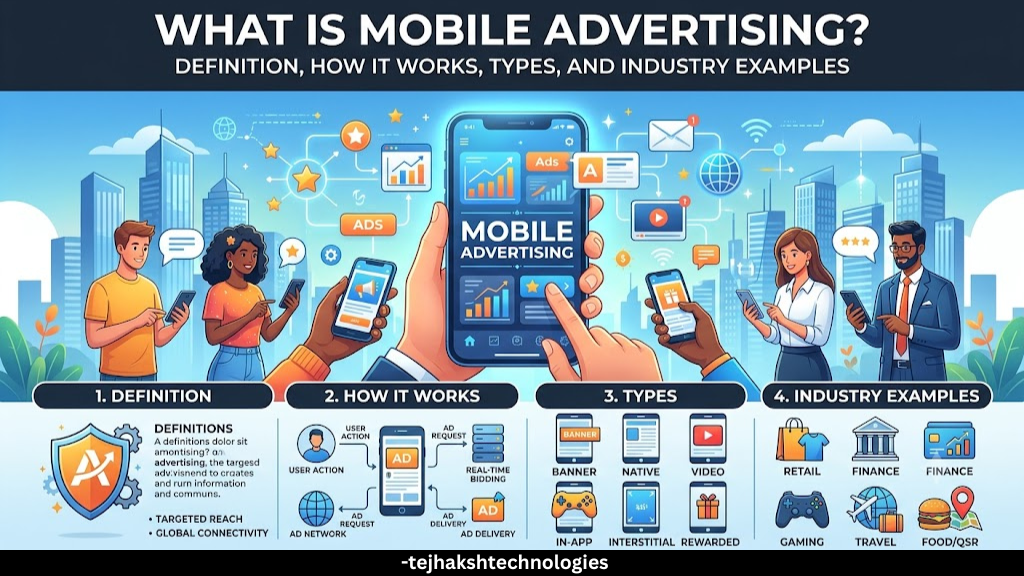
Mobile advertising refers to promoting a product, service, or brand by displaying advertisements to people on devices such as mobile phones, smartphones, and tablets. It is a subset of digital marketing that specifically targets mobile users.
Today, most people use the internet via mobile devices. They browse websites, use social media, shop online, watch videos, and utilize various apps on their phones. Promotional ads appearing on these platforms are part of mobile advertising.
Understanding mobile advertising with examples:
Imagine you are playing a game on your mobile phone, and an advertisement for a product appears in the middle of the game. This is an example of mobile advertising.
Similarly, when you are viewing videos or posts on apps like Instagram, Facebook, or YouTube, and a company’s “Sponsored Ad” appears in between, that too is considered mobile advertising.
Banners displayed on mobile websites, ads appearing during Google searches, or offers found within an app can also be examples of mobile advertising.
What is the objective of Mobile Advertising?
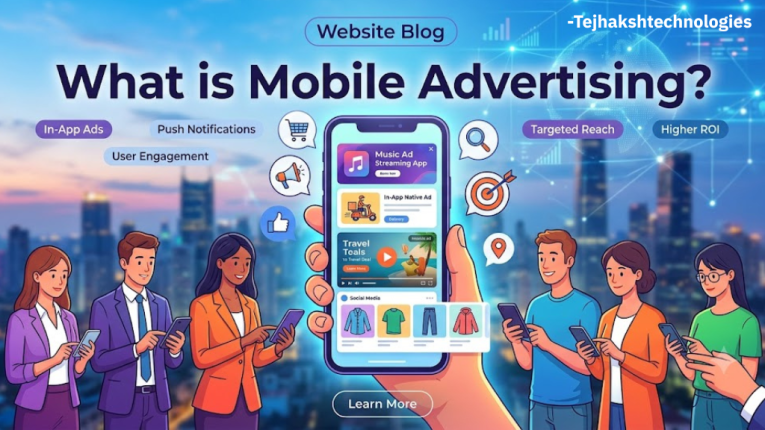
The primary objective of mobile advertising is to convey information about a brand, product, or service to the right audience at the right time. Through mobile ads, companies aim to reach new customers, boost sales, drive traffic to their websites or apps, and strengthen brand recognition.
A simple definition of mobile advertising
Mobile advertising is a method of promoting a product, service, app, or brand by displaying advertisements on smartphones and other mobile devices.
How Does Mobile Advertising Work?
Mobile advertising works by connecting businesses with people through their smartphones, tablets, apps, websites, social media platforms, and other mobile services.
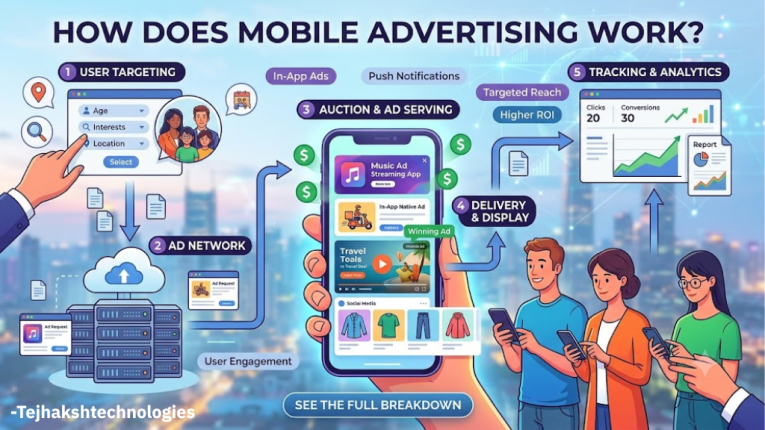
In simple terms, a company creates an advertisement, chooses the type of audience it wants to reach, shows the ad on mobile platforms, and then checks how people respond to it.
Here is a simple step-by-step explanation of how mobile advertising works:
1. The Business Creates an Ad Campaign
First, a business decides what it wants to promote. It could be a new product, service, mobile app, website, event, discount, or special offer.
The company also decides what it wants to achieve through the campaign. For example, it may want to:
- Make more people aware of its brand
- Bring visitors to its website
- Increase app downloads
- Generate more sales
- Collect customer leads
- Encourage people to visit a physical store
2. The Right Audience Is Selected
After setting the campaign goal, the advertiser decides who should see the advertisement.
Depending on the advertising platform and applicable privacy rules, businesses may use factors such as location, age group, interests, device type, search activity, or previous interactions with a brand.
Choosing the right audience helps businesses show their ads to people who are more likely to be interested in what they offer.
3. The Advertisement Is Displayed
Once the campaign is ready, the advertisement is shown through different mobile platforms.
For example, an ad may appear:
- Inside a mobile app
- On a mobile website
- In a social media feed
- In a mobile game
- On a search engine
- Through an advertising network
The type of advertisement can vary from banners and images to videos, sponsored posts, and interactive ads.
4. Users See or Interact With the Ad
When people use their phones or tablets, they may come across these advertisements while browsing, watching videos, using an app, playing a game, or scrolling through social media.
Depending on the type of ad, users may:
- Watch a video
- Click on the advertisement
- Visit a website
- Download an app
- Fill out a form
- Purchase a product
- Contact a business
- Visit a physical store
The user’s action helps the advertiser understand whether the advertisement is working effectively.
5. Campaign Results Are Analyzed
After the ads have been running, advertisers check their performance. They use different measurements to understand how many people saw the ad and how many took action.
Some common metrics include:
- Impressions: How many times an advertisement was displayed.
- CTR (Click-Through Rate): The percentage of people who clicked on the ad.
- CPC (Cost Per Click): The cost an advertiser pays whenever a user clicks on an ad.
- CPA (Cost Per Acquisition): The cost of getting a desired customer action, such as a purchase or signup.
- Conversion Rate: The share of users who complete the action a campaign is designed to achieve.
- ROAS (Return on Ad Spend): The revenue generated compared with the money spent on advertising.
- App Installs: The number of people who downloaded an advertised app.
- Leads: The number of potential customers generated through the campaign.
6. The Campaign Is Improved
The collected data helps advertisers understand what is working and what needs improvement. They can then adjust the audience, advertisement, budget, placement, or other campaign settings.
This process allows businesses to make their mobile advertising more effective and get better results over time.
In Simple Words
Mobile advertising follows a basic process: create an advertisement → choose the right audience → display the ad on mobile platforms → users interact with it → measure the results → improve the campaign.
This makes mobile advertising a useful way for businesses to connect with potential customers where they spend a large part of their online time—their mobile devices.
Special Considerations in Mobile Advertising
Mobile advertising is different from traditional advertising because people use their smartphones frequently and carry them everywhere. Businesses should keep a few important things in mind when creating mobile ads.
1. Small Screen Size
Mobile ads should be simple, clear, and easy to read. Too much text or a complicated design can make the ad difficult to understand.
2. User Experience
Ads should not disturb users. Ads that load slowly, cover the entire screen, or interrupt content too often can create a poor experience.
3. Privacy
Businesses must handle user data carefully and follow applicable privacy laws, consent requirements, and platform policies.
4. Location-Based Advertising
Mobile devices can allow businesses to show relevant offers based on a user’s location, where permitted. For example, a nearby restaurant can promote a special discount to local customers.
Location data should always be used responsibly and transparently.’
5. Mobile Page Speed
Mobile users expect websites and landing pages to load quickly. Slow pages can make users leave and reduce advertising results.
Businesses should focus on:
- Fast-loading websites
- Optimized images
- Quick landing pages
- Easy navigation
- Clear call-to-action buttons
Overall, mobile ads should be simple, fast, useful, user-friendly, and privacy-conscious.
Mobile Advertising Models
There are various methods in mobile advertising based on which advertisers make payments. The most common models are CPC, CPM, CPA, and CPI.
1. Cost Per Click (CPC)
CPC stands for Cost Per Click. In this model, the advertiser pays when a user clicks on their advertisement.
This model is primarily used for website traffic and search advertising.
Example: If 100 people view the ad but only 10 people click on it, the payment is based on the clicks.
2. Cost Per Mille (CPM)
CPM stands for Cost Per Thousand Impressions. Here, the advertiser pays based on the advertisement being displayed 1,000 times.
This model is particularly useful for campaigns where the primary objective is brand awareness and reaching a wider audience.
3. Cost Per Action (CPA)
CPA stands for Cost Per Action. In this model, the advertiser pays when a user completes a specific action.
This action could be:
- Filling out a form
- Registering
- Purchasing a product
- Signing up for an app or service
This model is highly effective in performance-based advertising.
4. Cost Per Install (CPI)
CPI stands for Cost Per Install. It is primarily used in mobile app advertising.
In this model, the advertiser pays when a user installs the app after viewing or interacting with the advertisement.
Example: If 500 people viewed the ad and 50 people installed the app, the campaign cost would be determined based on the app installs.
Types of Mobile Advertising
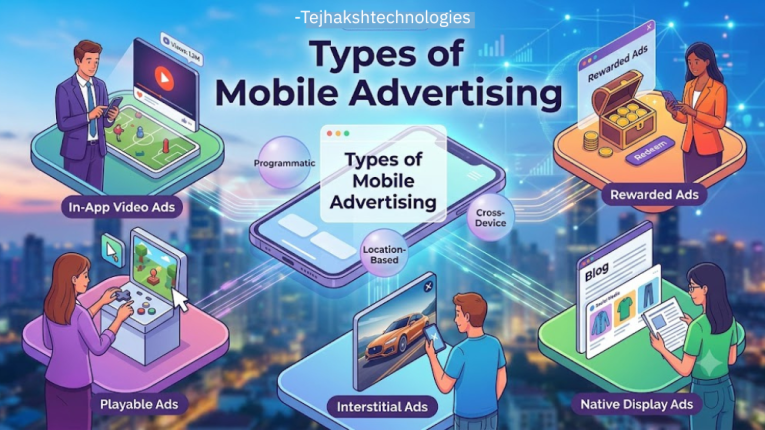
Mobile advertising comes in many different formats. Each type is designed for a specific purpose, such as increasing brand awareness, driving traffic, generating sales, or getting app downloads.
1. Mobile Banner Ads
Banner ads are rectangular advertisements that appear on mobile websites or inside apps. They are one of the most common types of mobile ads.
They may include:
- Brand logo
- Product image
- Short promotional message
- Call-to-action button
2. Mobile Video Ads
Video ads use short videos to promote a product, service, brand, or app. They can appear before or during videos, inside apps, or on social media.
Video ads can be effective because they combine images, sound, movement, and storytelling.
3. Native Ads
Native ads are designed to look similar to the regular content of the app or website where they appear.
For example, a sponsored post on social media may look like a normal post but is clearly marked as sponsored.
4. Mobile Search Ads
Search ads appear when users search for something on a search engine using their mobile device.
For example, someone searching for “best restaurant near me” may see sponsored results from local businesses.
These ads can be effective because users are already looking for a product or service.
5. Social Media Ads
Social media is one of the most popular channels for mobile advertising. Businesses can promote:
- Products and services
- Videos and images
- Special offers
- Website content
- App downloads
Social media platforms also offer tools to target specific audiences and measure ad performance.
6. Interstitial Ads
Interstitial ads are full-screen advertisements that appear at natural breaks in an app or website.
For example, a full-screen ad may appear between two levels of a mobile game.
Since these ads cover the entire screen, they should be used carefully to avoid disturbing users.
7. Rewarded Ads
Rewarded ads are commonly used in mobile games. Users choose to watch or interact with an advertisement in exchange for a reward.
Rewards may include:
- Extra points
- Virtual coins
- Extra lives
- Bonus features
This type of ad can be useful because both the user and advertiser can get value from the interaction.
8. App Install Ads
App install ads encourage users to download a mobile application. They usually include a clear button such as “Install,” “Download,” or “Get the App.”
These ads are commonly used by app developers, gaming companies, e-commerce businesses, and financial apps to attract new users.
In Simple Words
Mobile advertising can include banners, videos, native ads, search ads, social media ads, full-screen ads, rewarded ads, and app install ads. Businesses choose the format based on their advertising goals and target audience.
Mobile Advertising vs. Mobile Marketing
Mobile advertising and mobile marketing may sound similar, but they have different meanings.
Mobile advertising mainly means showing paid advertisements to people on their smartphones and other mobile devices. For example, banner ads, video ads, social media ads, and search ads are all forms of mobile advertising.
Mobile marketing is a much broader term. It includes different ways of connecting with customers through mobile devices.
Mobile marketing can include:
- SMS marketing
- Mobile advertising
- Push notifications
- Mobile apps
- Mobile-friendly websites
- Mobile email marketing
- Location-based marketing
- Mobile search optimization
Simple Difference
- Mobile Advertising: Paid ads shown to users on mobile devices.
- Mobile Marketing: A wider marketing strategy that uses mobile devices and different mobile channels to reach and engage customers.
In simple words, mobile advertising is one part of mobile marketing.
Advantages of Mobile Advertising
Mobile advertising offers many benefits to businesses. It helps companies reach customers, promote their products, and measure the results of their campaigns.
1. Large Audience
Billions of people use smartphones every day. This gives businesses a huge number of potential customers to reach through mobile advertising.
2. High User Engagement
People use their phones frequently for browsing, shopping, watching videos, and social media. This gives businesses many chances to connect with their audience.
3. Better Audience Targeting
Mobile advertising platforms can help businesses reach specific groups based on factors such as location, interests, demographics, and online activity, subject to applicable privacy requirements.
4. Flexible Budget
Businesses can choose an advertising budget that suits their needs. Different pricing models, such as CPC, CPM, CPA, and CPI, allow both small and large businesses to run mobile ad campaigns.
5. Easy to Measure
Mobile advertising provides useful data about campaign performance. Businesses can track views, clicks, conversions, app installs, and other results.
6. Quick Optimization
Advertisers can see campaign results and make changes when needed. They can adjust the audience, budget, ad design, or placement to improve performance.
Disadvantages of Mobile Advertising
Mobile advertising has many benefits, but it also comes with some challenges. Businesses need to understand these drawbacks before planning a mobile advertising campaign.
1. Small Screen Size
Mobile phones have limited screen space. This can make it difficult to show too much information in an advertisement. Ads need to be simple, clear, and easy to understand.
2. Ad Fatigue
People may get bored or annoyed when they see the same advertisement again and again. Repeated ads can reduce user interest and make the campaign less effective.
3. Privacy Concerns
Mobile advertising may involve the use of user information for targeting. This can create privacy concerns. Businesses must handle user data responsibly and follow applicable privacy laws and platform policies.
4. Ad Blocking
Some users use ad blockers or privacy settings that can prevent certain advertisements from being displayed. This can reduce the number of people who see an ad.
5. Intrusive Ads
Ads that suddenly cover the screen, interrupt content, or are difficult to close can annoy users. Poorly designed ads may create a negative impression of the brand.
6. High Competition
Many businesses advertise on mobile platforms, so competition for users’ attention can be high. In popular markets, this competition may also increase advertising costs.
Mobile Advertising Best Practices
Businesses can make their mobile advertising more effective by following a few simple practices. The main goal should be to create ads that are clear, useful, fast, and easy for users to interact with.
1. Keep Ads Simple
Mobile users usually scroll quickly, so your message should be short and easy to understand. Highlight the main benefit of the product or service right away.
2. Use Attractive Visuals
Good-quality images and short videos can grab users’ attention and make an advertisement more engaging.
3. Add a Clear Call to Action
Tell users exactly what you want them to do. For example:
- Shop Now
- Learn More
- Download Now
- Sign Up
- Get Started
4. Optimize the Landing Page
The page users reach after clicking an ad should work well on mobile devices. It should load quickly, be easy to navigate, and match the information or offer shown in the advertisement.
5. Test Different Ads
Try different headlines, images, videos, offers, and call-to-action buttons. Testing different versions can help businesses find out which ads perform better.
6. Respect User Privacy
Businesses should use customer data responsibly and follow applicable privacy laws and platform rules. When required, they should also provide clear information and obtain proper user consent.
The Future of Mobile Advertising
Mobile advertising is changing quickly as smartphones, apps, social media, artificial intelligence, and online shopping continue to grow.
In the coming years, businesses are likely to focus more on personalized ads, short videos, interactive content, app-based advertising, and privacy-friendly advertising methods.
Artificial intelligence is also becoming an important part of mobile advertising. It can help businesses understand campaign data, find useful patterns, automate some advertising tasks, and create different versions of ads.
However, technology alone is not enough. For mobile advertising to be successful, businesses also need to create relevant content, useful offers, engaging ads, and a smooth user experience.
Conclusion
Mobile advertising is an important part of digital marketing. It helps businesses reach customers through smartphones, apps, websites, search engines, and social media.
Businesses can use different formats such as banner ads, video ads, native ads, search ads, rewarded ads, and app install ads to achieve their marketing goals.
For better results, mobile advertising should be simple, relevant, fast, user-friendly, and privacy-conscious.
When used correctly, it can help businesses increase brand awareness, attract website visitors, generate leads, increase app downloads, and grow sales.
Frequently Asked Questions About Mobile Advertising
1. What is mobile advertising in simple words?
Ans. Mobile advertising is the practice of displaying paid advertisements to people through smartphones, tablets, mobile apps, mobile websites, search engines, and social media platforms.
2. What are the main types of mobile advertising?
Ans. The main types include banner ads, video ads, native ads, search ads, social media ads, interstitial ads, rewarded ads, and app install advertisements.
3. What is an example of mobile advertising?
Ans. A sponsored social media post, an advertisement inside a mobile game, a banner on a mobile website, or a video advertisement shown in a mobile application are all examples of mobile advertising.
4. What is the difference between mobile advertising and mobile marketing?
Ans. Mobile advertising refers mainly to paid advertisements delivered through mobile channels, while mobile marketing is a broader strategy that includes advertising, SMS, push notifications, mobile apps, mobile websites, and other mobile-based marketing activities.
5. Is mobile advertising effective?
Ans. Mobile advertising can be effective when businesses use relevant audiences, compelling creative content, suitable ad formats, clear calls to action, optimized landing pages, and proper performance measurement.
6. What are common mobile advertising models?
Ans. Common models include CPC (Cost Per Click), CPM (Cost Per Mille), CPA (Cost Per Action), and CPI (Cost Per Install).
Leave a Comment