- September 23, 2026
- Tejhaksh
- 0 Comments
- Uncategorized
What Is Continuous Modernization? Benefits, Process, and Best Practices
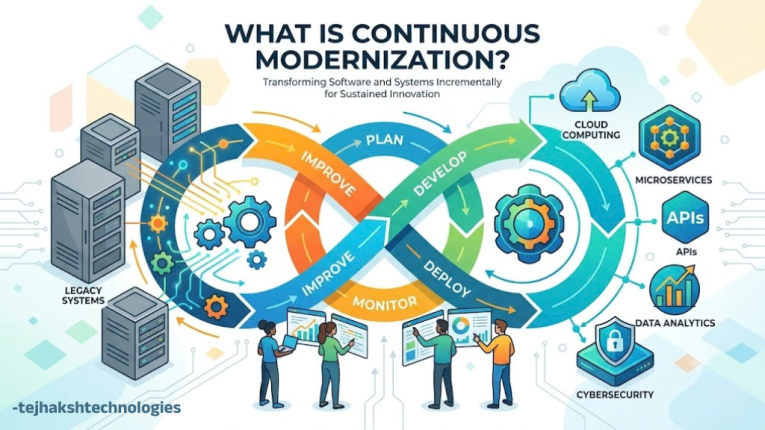
Technology is changing faster than ever, and businesses need to continuously improve their digital systems to keep up with changing customer expectations, security requirements, and market competition. Older applications and IT infrastructure can become difficult to maintain, expensive to operate, and challenging to integrate with modern technologies.
This is where Continuous Modernization (CM) becomes important.
Continuous Modernization is an ongoing approach to improving, updating, and transforming applications, infrastructure, data platforms, and technology processes. Instead of waiting for systems to become outdated before replacing them, organizations continuously modernize their technology environment in smaller, manageable steps.
In this guide, we will explain what Continuous Modernization is, its benefits, the modernization process, best practices, and how businesses can realize the benefits of Continuous Modernization.
What Is Continuous Modernization?
Continuous Modernization is the practice of regularly improving existing technology systems to keep them secure, scalable, efficient, and aligned with business requirements.
Traditional modernization often involves a large, one-time project where an organization attempts to replace or significantly upgrade an entire legacy system. Continuous Modernization takes a different approach. It treats modernization as an ongoing business and technology strategy.
Businesses can continuously modernize areas such as:
- Legacy applications – Updating or improving older software systems.
- Cloud infrastructure – Moving workloads to the cloud or improving existing cloud environments.
- Databases and data platforms – Upgrading systems to manage and process data more efficiently.
- APIs and integrations – Improving how different applications and systems communicate with each other.
- Operating systems – Replacing outdated or unsupported operating systems.
- Development tools – Using modern tools to make software development faster and more efficient.
- Security technologies – Improving security controls to protect systems and data.
- User interfaces – Creating simpler and more user-friendly digital experiences.
- Business processes – Automating and improving manual or inefficient processes.
- IT architecture – Updating the overall technology structure to support future growth.
For example, a company may begin by moving part of a legacy application to the cloud. It can then modernize its database, improve APIs, automate deployment processes, and gradually replace outdated components.
The focus is on using technology that delivers real value to the business. The goal is to continuously improve technology in ways that create measurable business value.
Why Is Continuous Modernization Important?
Many organizations still depend on legacy applications and older technology that were developed years or even decades ago. While these systems may still support important business functions, they can become difficult and expensive to maintain over time.
Older technology can create several challenges for businesses, such as:
- Higher maintenance costs – Older systems often require more time and resources to maintain.
- Security risks – Outdated software may not receive regular security updates, increasing the risk of vulnerabilities.
- Integration problems – Legacy systems may not work easily with modern applications, cloud platforms, or other technologies.
- Limited scalability – Older systems may struggle to handle growing users, data, or business requirements.
- Slower development – Adding new features or making changes can take more time with outdated technologies.
- Growing technical debt – Delaying updates can make future improvements more difficult and expensive.
- Poor user experience – Older applications may not provide the speed and usability that modern users expect.
- Limited support for new technologies – Legacy systems may not easily support cloud computing, automation, artificial intelligence, or modern development tools.
Waiting too long to address these challenges can make modernization more expensive, complex, and disruptive.
Continuous Modernization helps organizations solve these problems through small, regular improvements. This approach reduces disruption while keeping technology secure, efficient, scalable, and aligned with changing business needs.
What are the Benefits of Continuous Modernization?
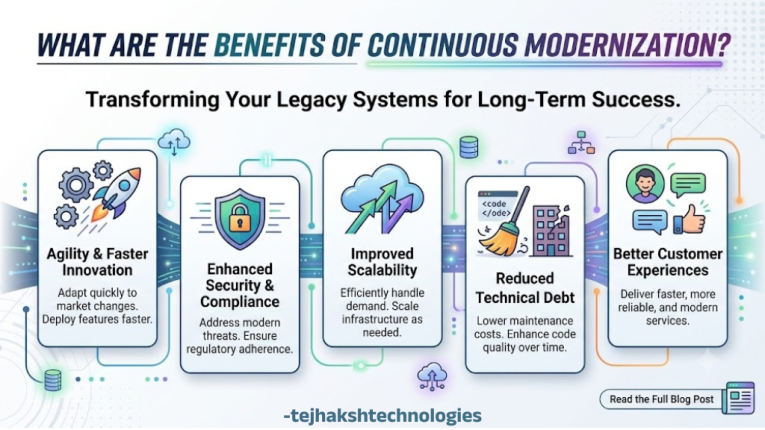
Continuous Modernization can provide several business and technology benefits. Four important benefits include increased customer satisfaction, reduced risk, reduced technical debt, and sustained innovation.
1. Increased Customer Satisfaction
Customer expectations are constantly changing. Users expect websites, applications, and digital services to be fast, reliable, secure, and easy to use.
Outdated systems can make it difficult for businesses to deliver these experiences.
Continuous Modernization allows organizations to improve applications and services regularly. Businesses can introduce performance improvements, modern interfaces, better integrations, and new digital capabilities without waiting for a major technology replacement project.
For example, an organization may modernize an application by improving its API architecture, optimizing its database, or migrating selected workloads to cloud infrastructure.
These improvements can result in:
- Faster application performance
- Better digital experiences
- Improved reliability
- Easier access to services
- Faster feature releases
- More responsive customer support
When technology consistently meets customer expectations, organizations can improve customer satisfaction and strengthen long-term relationships.
2. Reduced Risk
Technology risk can come from outdated software, unsupported platforms, security vulnerabilities, operational dependencies, and complex architectures.
A large modernization project can also introduce risk because organizations may need to change multiple systems simultaneously.
Continuous Modernization can help reduce these risks by allowing businesses to make smaller and more controlled changes.
Organizations can gradually:
- Upgrade outdated components
- Improve security controls
- Replace unsupported technologies
- Modernize infrastructure
- Automate testing and deployment
- Improve monitoring
- Strengthen disaster recovery capabilities
Smaller modernization initiatives can also make it easier to identify problems early. Instead of discovering issues after a large transformation is completed, teams can test and validate changes incrementally.
This approach can help organizations maintain greater control over their technology environment.
3. Reduced Technical Debt
Technical debt refers to the future cost and complexity created when organizations choose quick or outdated technology solutions instead of addressing underlying technical problems.
Technical debt can accumulate when applications are not regularly maintained or modernized.
For example, an organization may continue using an outdated framework because migrating the application seems difficult. Over time, developers may need to create workarounds to keep the system functioning. Eventually, even simple changes can become expensive and time-consuming.
Continuous Modernization provides a way to address technical debt gradually.
Teams can identify high-risk or high-cost areas and modernize them incrementally. This may include:
- Refactoring outdated code
- Updating frameworks
- Removing obsolete components
- Improving application architecture
- Automating manual processes
- Modernizing databases
- Improving APIs
- Reducing unnecessary dependencies
By managing technical debt continuously, organizations can prevent small technology problems from becoming major modernization challenges.
4. Sustained Innovation
Innovation depends on an organization’s ability to adopt new technologies and respond to changing market requirements.
Highly outdated technology environments can make innovation difficult. Developers may spend significant time maintaining legacy applications instead of creating new capabilities.
Continuous Modernization creates a technology environment that is better prepared for ongoing innovation.
Modern architectures can make it easier to integrate technologies such as:
- Cloud computing
- Artificial intelligence
- Machine learning
- Automation
- Data analytics
- Modern APIs
- Containerization
- Microservices
Modernization does not mean adopting every new technology. Instead, businesses can evaluate which technologies support their specific objectives and introduce them when there is a clear business or operational benefit.
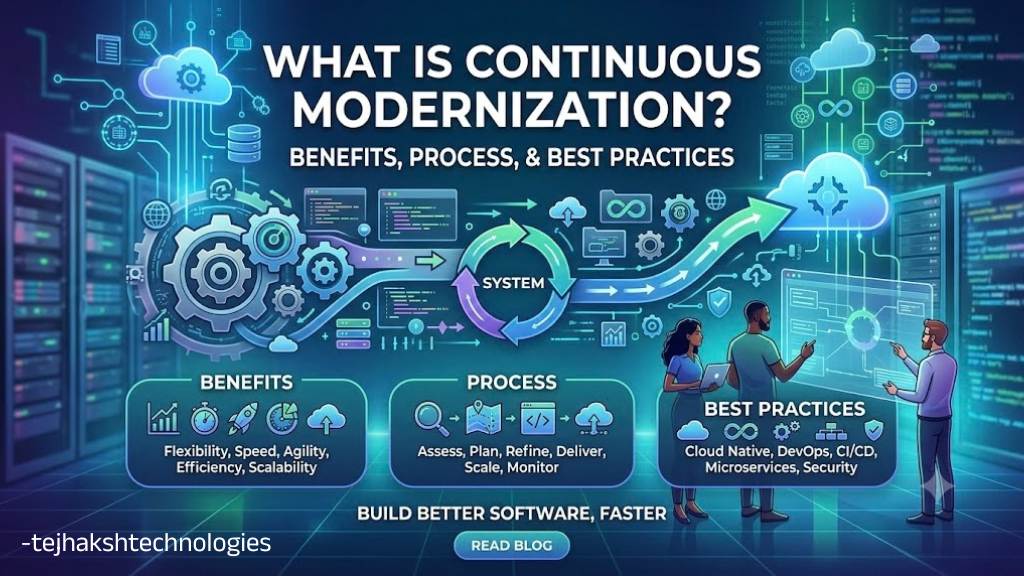
Continuous Modernization Process
A successful Continuous Modernization strategy requires more than simply upgrading software. Organizations need a structured process that connects technology improvements with business objectives.
Step 1: Assess the Existing Technology Environment
The first step is understanding the current technology landscape.
Organizations should identify:
- Applications and systems
- Infrastructure
- Databases
- Dependencies
- Integration points
- Security risks
- Technical debt
- Maintenance costs
- Performance limitations
This assessment helps organizations determine which systems require immediate attention and which can continue operating with minimal changes.
Step 2: Define Business and Technology Goals
Modernization should be connected to measurable business objectives.
For example, an organization may want to:
- Improve application performance
- Reduce infrastructure costs
- Improve security
- Increase scalability
- Accelerate product development
- Improve customer experience
- Support cloud adoption
Clearly defined goals help teams determine which modernization activities should receive priority.
Step 3: Prioritize Modernization Opportunities
Not every application needs to be modernized at the same time.
Organizations can prioritize systems based on factors such as business importance, security risk, technical debt, operating cost, scalability requirements, and modernization complexity.
A phased approach allows businesses to focus resources where modernization can provide meaningful value.
Step 4: Select the Right Modernization Approach
Different systems require different modernization strategies.
Common approaches include:
- Rehosting: Moving an application to a new infrastructure environment with limited changes.
- Replatforming: Moving an application to a modern platform while making selected improvements.
- Refactoring: Changing application code or architecture to improve maintainability and performance without necessarily changing its core functionality.
- Rearchitecting: Redesigning an application’s architecture to support new requirements such as scalability and cloud-native capabilities.
- Replacing: Replacing an outdated system with a modern application or platform.
The right approach depends on the organization’s business requirements, budget, technical environment, and long-term goals.
Step 5: Implement Changes Incrementally
Continuous Modernization works best when changes are introduced in manageable stages.
Organizations can modernize one application component, service, database, or infrastructure layer at a time.
Incremental modernization can help reduce disruption and provide opportunities to learn from each implementation.
Step 6: Test, Monitor, and Measure
Modernization should not end when a new technology is deployed.
Teams should monitor:
- Application performance
- System availability
- Security
- Infrastructure costs
- User experience
- Deployment frequency
- Error rates
- Business outcomes
These measurements help organizations understand whether modernization efforts are delivering the expected benefits.
Step 7: Continue the Modernization Cycle
The final step is to make modernization an ongoing practice.
Technology environments continuously change. New security requirements, customer expectations, business models, and technologies will emerge.
Organizations should regularly reassess their technology environment and identify new modernization opportunities.
Continuous Modernization Best Practices
Businesses can improve the results of their modernization initiatives by following several best practices.
Start With Business Outcomes
Technology modernization should support measurable business goals. Avoid modernizing systems simply because a newer technology exists.
Take an Incremental Approach
Large technology transformations can be complex. Breaking modernization into smaller initiatives can make planning, testing, and risk management easier.
Automate Where Possible
Automation can improve consistency and reduce manual effort. Organizations can use automated testing, deployment, infrastructure provisioning, monitoring, and security checks as part of their modernization strategy.
Prioritize Security
Security should be incorporated into modernization from the beginning rather than treated as a final step.
Modernized systems should include appropriate access controls, monitoring, vulnerability management, data protection, and security testing.
Manage Technical Debt Continuously
Technical debt should be treated as an ongoing technology-management concern. Regularly identifying and addressing outdated components can prevent technical debt from becoming increasingly difficult to manage.
Use Data to Guide Decisions
Organizations should use application performance, infrastructure costs, customer feedback, security data, and operational metrics to determine where modernization can create the greatest value.
Prepare Teams for Change
Modernization often requires new skills and changes to development and operational processes.
Organizations should provide appropriate training and encourage collaboration between development, IT operations, security, and business teams.
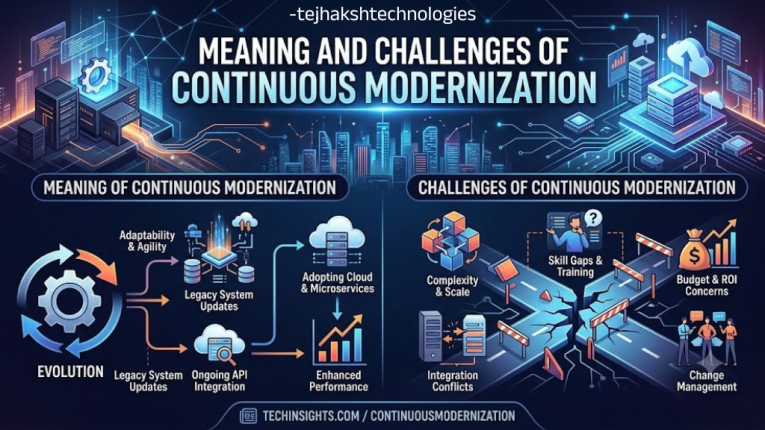
Challenges of Continuous Modernization
Although Continuous Modernization offers several potential benefits, organizations may face challenges during implementation.
Legacy Dependencies
Older applications may have complex dependencies that make modernization difficult.
Skills Gaps
Teams may need expertise in cloud platforms, modern application architecture, automation, cybersecurity, data platforms, and other technologies.
Budget Constraints
Modernization requires investment in technology, people, tools, and training.
Resistance to Change
Organizations may face adoption challenges as employees and stakeholders adjust to new systems and ways of working.”
Integration Complexity
Modernization can become complex when applications, databases, and integrations depend on each other.
These challenges can be addressed through careful planning, phased implementation, technical assessment, and ongoing measurement.
How to Realize the Benefits of Continuous Modernization
To get the most from Continuous Modernization, businesses should treat it as an ongoing strategy rather than a one-time IT project.
Start by reviewing your current technology, identifying key challenges, and setting clear modernization goals. Then, prioritize important areas and make improvements step by step instead of changing everything at once.
A successful Continuous Modernization strategy includes:
- Business-focused goals
- Incremental modernization
- Application and cloud improvements
- Technical debt management
- Strong security
- Automation and monitoring
- Performance measurement
- Continuous team training
By following this approach, businesses can keep their technology secure, efficient, scalable, and ready for changing business needs.
Conclusion
Continuous Modernization provides organizations with a structured way to continuously improve technology instead of waiting until legacy systems become major obstacles.
By modernizing applications, infrastructure, data platforms, and processes incrementally, businesses can work toward increased customer satisfaction, reduced risk, reduced technical debt, and sustained innovation.
The most effective approach starts with understanding the existing environment, defining business objectives, prioritizing modernization opportunities, selecting appropriate modernization strategies, and continuously measuring results.
Technology will continue to evolve, and businesses that regularly evaluate and improve their technology environment can remain better prepared for changing customer expectations and business requirements.
Ultimately, Continuous Modernization is not simply about adopting new technology. It is about creating a sustainable approach to technology improvement that allows an organization to modernize continuously, manage technical debt, reduce risk, and support long-term innovation.

Leave a Comment