


- September 7, 2026
- Tejhaksh
- 0 Comments
- Cryptography, Uncategorized
What Is Cryptography? Meaning, Types, Uses, Features and How It Works
In the digital age, huge amounts of personal, financial and business information are shared online every day. From online banking and digital payments to emails, websites and mobile applications, sensitive data needs to be protected from unauthorized access. Cryptography is one of the most important technologies used to secure this information.
Cryptography uses mathematical techniques to protect data and communication. It can help keep information confidential, detect unauthorized changes, verify identities and support secure digital transactions.
But what is cryptography, how does it work, and what are its different types?
In this article, we will explain cryptography meaning, cryptographic meaning, features of cryptography, its importance, working, types, common uses, cryptographic keys, key management, algorithms and encryption methods in simple language.
Cryptography Meaning
Cryptography is a method of protecting information using mathematical techniques. It helps ensure that sensitive data can be accessed or understood only by authorized users.
The original readable information is called plaintext. Cryptography can convert plaintext into an unreadable or protected form called ciphertext. The intended user can then use the correct key or cryptographic method to access the original information.
For example, when you send sensitive information over the internet, cryptography helps protect the data while it is being transferred between your device and the receiving system.
Today, cryptography is widely used in cybersecurity, online banking, digital payments, secure websites, messaging apps, cloud services and many other digital systems to help keep information secure.
What Is Cryptographic?
Cryptographic is a term used for anything that is related to cryptography and the protection of information.
It can describe the tools, techniques, algorithms, keys and systems used to keep digital data secure.
Here are some common examples:
- Cryptographic Key: A piece of information used by a cryptographic system to encrypt, decrypt or protect data.
- Cryptographic Algorithm: A mathematical method used for encryption, decryption, hashing and other security operations.
- Cryptographic Protocol: A set of rules that uses cryptographic techniques to help establish secure communication.
- Cryptographic Hash: A fixed-length value created from data using a cryptographic hash function. It can be used to help verify data integrity.
In simple words, cryptography is the broader field of protecting information, while cryptographic describes the tools and techniques used in that field.
Features of Cryptography
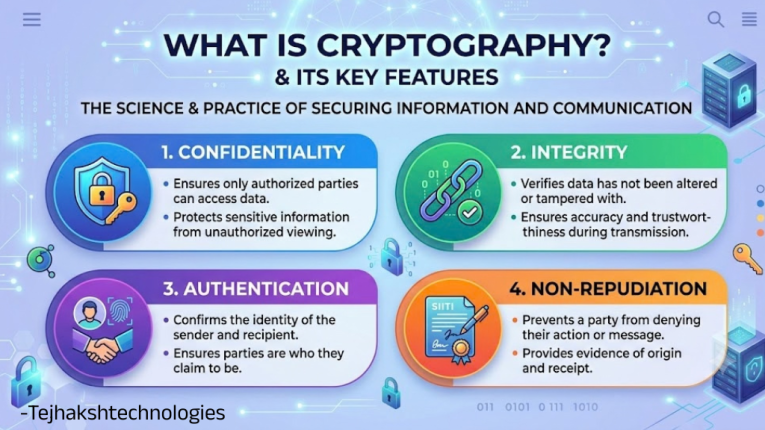
Cryptography provides several important security features that help protect digital information and keep online communication secure. The main features include:
1. Confidentiality
Confidentiality means keeping sensitive information private and allowing access only to authorized users. Encryption helps protect data from being read by unauthorized people.
2. Data Integrity
Cryptography helps ensure that data has not been changed or tampered with during storage or transmission. Hashing and other cryptographic techniques can help detect unwanted changes.
3. Authentication
Cryptographic methods can help verify the identity of users, devices or systems. This helps ensure that communication is taking place with the intended party.
4. Non-Repudiation
Non-repudiation helps provide proof that a particular person or system performed or approved a digital action. Digital signatures are commonly used for this purpose.
5. Secure Communication
Cryptography helps protect information exchanged between users, devices, applications and servers, especially when data is sent over the internet or other untrusted networks.
Overall, these features make cryptography an important part of cybersecurity and modern data protection.
Why Is Cryptography Important?
The importance of cryptography has increased with the rapid growth of internet-based services.
Every day, people share sensitive information such as passwords, payment details, personal documents and business data online. Without suitable security measures, this information could be exposed, modified or misused.
Cryptography is important because it helps:
- Protect confidential and sensitive information
- Secure online banking and digital transactions
- Protect data while it is being transmitted
- Detect unauthorized changes to information
- Verify the identity of users and systems
- Protect data stored on devices and servers
- Support digital signatures
- Improve overall data and communication security
However, cryptography is only one part of cybersecurity. Strong passwords, access controls, software updates, secure system design and monitoring are also important for protecting digital systems.
Working of Cryptography
The working of cryptography depends on the type of technique being used. In simple encryption, readable information is converted into a protected form so that unauthorized people cannot easily understand it. An authorized user can then use the correct key and method to access the original information.
The basic process works as follows:
Step 1: Plaintext
The process begins with the original, readable information. This is called plaintext.
Step 2: Encryption
The plaintext is processed using an encryption algorithm and cryptographic key. It is converted into a protected form called ciphertext.
Step 3: Transmission or Storage
The ciphertext can then be sent over a network or stored on a device or server. Since the information is protected, it is harder for unauthorized users to understand.
Step 4: Decryption
The authorized recipient uses the appropriate key and decryption method to convert the ciphertext back into the original readable information.
The basic process can be shown as:
Plaintext → Encryption → Ciphertext → Decryption → Plaintext
It is important to note that not all cryptographic techniques use encryption and decryption. For example, hashing is mainly used to verify data and detect changes rather than to recover the original information.
Types of Cryptography
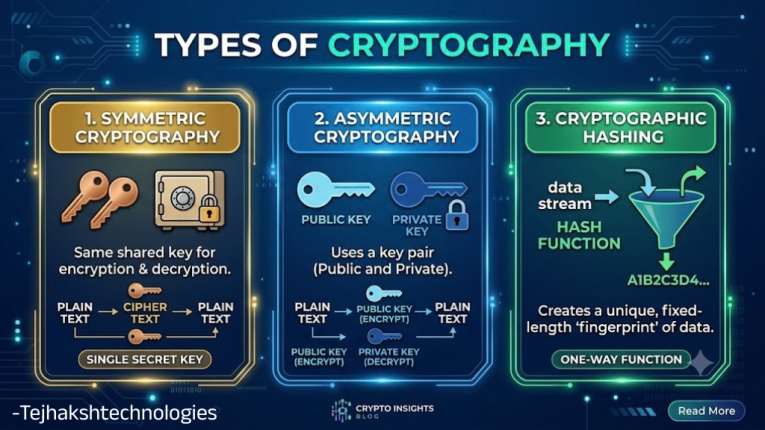
Cryptography can be divided into different types based on how information is protected. The three commonly used types are symmetric cryptography, asymmetric cryptography and cryptographic hashing.
1. Symmetric Cryptography
Symmetric cryptography uses the same secret key to encrypt and decrypt data.
The sender and the authorized recipient both need access to the same key. Since symmetric encryption is generally fast and efficient, it is often used to protect large amounts of data.
Examples: AES and ChaCha20
Main advantage: Fast and efficient for encrypting large amounts of data.
Main challenge: The secret key must be securely shared and protected. If someone gets access to the key, they may be able to decrypt the protected data.
2. Asymmetric Cryptography
Asymmetric cryptography, also known as public-key cryptography, uses two related keys:
- Public Key: Can generally be shared with others.
- Private Key: Must be kept secret and securely protected.
The two keys work together for different security operations. Asymmetric cryptography is commonly used for authentication, digital signatures and establishing secure communication.
Examples: RSA and Elliptic Curve Cryptography (ECC)
Compared with symmetric encryption, asymmetric cryptographic operations are generally slower and require more computing resources. However, they provide an important way to communicate securely without directly sharing a secret key.
3. Cryptographic Hashing
Cryptographic hashing uses a mathematical function to convert data into a fixed-length value called a hash or digest.
A cryptographic hash function is designed to make it computationally difficult to recover the original data from the hash. Even a small change in the original data can produce a different hash value.
Hashing is commonly used for:
- Data integrity verification
- File verification
- Digital signatures
- Password protection systems
Examples: SHA-256 and SHA-3
Unlike encryption, hashing is generally not designed to be reversed to recover the original data. It is mainly used to verify information and detect whether data has been changed.
Common Uses for Cryptography
Cryptography is an important part of modern digital security. It is used in many online services and technologies to protect information from unauthorized access, changes and misuse.
Here are some common uses of cryptography:
1. Online Banking
Banks use cryptographic technologies to help protect customer information, account details, online transactions and communication between customers and banking systems.
This helps keep sensitive financial information secure while users access their accounts or make transactions online.
2. Digital Payments
Digital payment systems use encryption and other security techniques to protect sensitive transaction information.
Cryptography helps secure information exchanged during payments and reduces the risk of unauthorized access to payment data.
3. Secure Websites
Websites that use HTTPS rely on cryptographic protocols to help protect communication between a web browser and the website’s server.
This helps prevent unauthorized users from easily viewing or changing information while it is being transmitted.’
4. Messaging Applications
Many messaging applications use encryption to help protect messages and other communications from unauthorized access.
Depending on the service and its design, encryption can help keep conversations private while messages are being transmitted or stored.
5. Password Protection
Secure systems use cryptographic hashing and specialized password-hashing techniques to protect stored passwords.
Instead of storing passwords in plain text, a secure system typically stores password hashes, making it harder for an attacker to obtain the original passwords if the stored data is exposed.
6. Digital Signatures
Digital signatures use cryptographic techniques to help verify the authenticity and integrity of digital documents, messages and transactions.
They can help confirm who signed or approved digital information and whether it has been changed after signing.
7. Cloud Services
Cloud platforms can use encryption to protect data while it is stored and while it is being transferred between users, applications and cloud servers.
This helps improve the security of sensitive files and other information stored in cloud environments.
8. VPNs
Virtual Private Networks (VPNs) can use cryptographic protocols to protect communication between a user’s device and the VPN server.
This helps secure network traffic, particularly when communicating over networks that may not be fully trusted.
9. File Verification
Cryptographic hash functions can be used to check whether a file has been changed or corrupted.
A hash can be calculated for a file and compared with a trusted hash value. If the values are different, it may indicate that the file has been modified or damaged.
Overall, cryptography plays an important role in protecting data, securing online communication and supporting digital trust across websites, banking, payments, messaging, cloud services and many other technologies.
Also read:
MongoDB for Beginners: Features, Advantages, Working, Use Cases & Environments (2026)
Custom Software Development Process: A Step-by-Step Guide for Beginners (2026)
What is Microsoft SQL Server? Features, History, Uses & Versions Explained
What is Microsoft Azure? Complete Guide for Beginners (Features, Uses & Benefits)
Cryptographic Keys and Key Management
A cryptographic key is information used by a cryptographic algorithm to perform operations such as encryption, decryption or digital signing.
Keys are an important part of cryptography. The security of a cryptographic system depends not only on using a strong algorithm but also on how securely the keys are created, stored and used.
Common Types of Cryptographic Keys
Different cryptographic systems use different types of keys. Common types include:
- Symmetric Keys: Used for both encryption and decryption in symmetric cryptography.
- Public Keys: Designed to be shared and are used in public-key cryptographic systems.
- Private Keys: Kept secret and used for operations such as decryption or creating digital signatures, depending on the system.
- Session Keys: Temporary keys used to protect communication during a particular session.
- Signing Keys: Keys used to create or verify digital signatures, depending on whether they are private or public.
In simple terms, a public key can generally be shared with others, while a private key must be kept secret and carefully protected.
What Is Key Management?
Cryptographic key management is the process of securely managing cryptographic keys throughout their entire lifecycle.
It can include:
- Key Generation: Creating secure cryptographic keys.
- Key Storage: Keeping keys in a secure location.
- Key Distribution: Providing keys to authorized users or systems.
- Key Usage: Controlling how and when keys can be used.
- Key Rotation: Replacing old keys with new ones at appropriate intervals.
- Key Backup: Creating secure backups when required.
- Key Recovery: Restoring keys when they are lost or unavailable.
- Key Revocation: Disabling keys that are no longer trusted or should not be used.
- Key Destruction: Securely deleting keys when they are no longer needed.
Proper key management is essential because even a strong cryptographic algorithm can become less effective if its keys are poorly protected.
Organizations should therefore use appropriate security policies, access controls and secure key-management practices to protect cryptographic keys from unauthorized access, loss or misuse.
Cryptographic Algorithms and Encryption Methods
A cryptographic algorithm is a mathematical procedure used to perform a security-related operation.
Here are some commonly used cryptographic algorithms:
AES
- AES (Advanced Encryption Standard) is a widely used symmetric encryption algorithm. It uses the same secret key for encryption and decryption.
- AES is commonly used to protect data stored on devices, servers and other systems, as well as data being transmitted through networks.
RSA
- RSA is a widely known public-key cryptographic algorithm that uses a public key and a private key.
It has been used for applications such as digital signatures, authentication and secure communication. RSA generally requires larger key sizes than some newer public-key approaches.
ECC
- ECC (Elliptic Curve Cryptography) is a type of public-key cryptography based on the mathematical properties of elliptic curves.
One of its main advantages is that it can provide strong security with smaller key sizes compared with some traditional public-key algorithms. This can make ECC useful in systems where computing power, storage or bandwidth is limited.
SHA-256
- SHA-256 is a cryptographic hash function from the SHA-2 family. It produces a fixed-length 256-bit hash value from input data.
- SHA-256 is commonly used for data integrity verification, file verification, digital signatures and other security applications.
SHA-3
- SHA-3 is a standardized family of cryptographic hash functions. It provides another approach to cryptographic hashing and can be used for applications such as data integrity and security-related hashing operations.
Main Encryption Methods
Encryption methods can broadly be categorized as:
1. Symmetric Encryption
Uses a shared secret key for encryption and decryption.
2. Asymmetric Encryption
Uses a public key and a private key for cryptographic operations.
3. Hybrid Encryption
Combines symmetric and asymmetric cryptography. Modern secure systems often use asymmetric techniques to establish or protect a shared secret and symmetric encryption to efficiently protect the actual data.

Advantages of Cryptography
Cryptography provides several important benefits for protecting digital information and online communication. It helps individuals, businesses and organizations keep their data secure.
Some major advantages of cryptography include:
- Protects confidential information: Helps keep sensitive data safe from unauthorized access.
- Secures online communication: Helps protect information shared between users, devices and servers.
- Maintains data integrity: Helps detect whether information has been changed or tampered with.
- Helps verify identities: Cryptographic techniques can help confirm the identity of users, devices or systems.
- Supports digital signatures: Helps verify the authenticity and integrity of digital documents and transactions.
- Protects stored data: Encryption can help protect sensitive information stored on computers, servers and other devices.
- Secures digital transactions: Helps protect online banking, digital payments and other electronic transactions.
Its effectiveness, however, depends on using appropriate algorithms, secure implementations and proper key management.
Limitations of Cryptography
Cryptography cannot protect a system from every type of security threat.
Some common limitations include:
- Poor key management can compromise security.
- Incorrect implementation can create vulnerabilities.
- Weak passwords can undermine otherwise strong security systems.
- Some cryptographic operations require significant computing resources.
- Cryptography cannot prevent every form of social engineering or unauthorized access.
For this reason, cryptography should be used as part of a complete cybersecurity strategy rather than as the only security measure.
Conclusion
Cryptography plays an important role in protecting information in today’s connected world. It helps secure sensitive data, protect digital communication, verify information and support trusted online services.
Understanding cryptography meaning, cryptographic meaning, features of cryptography, its importance, working, types, common uses, cryptographic keys, key management, algorithms and encryption methods provides a useful foundation for learning about cybersecurity.
Symmetric cryptography, asymmetric cryptography and hashing each serve different purposes. When these technologies are properly implemented and combined with secure key management and other cybersecurity practices, they can provide strong protection for modern digital systems.
Leave a Comment